

Is your social media ad spend a genuine investment or just an expensive hobby? With global social ad spend projected to hit $317.33 billion in 2026, it’s easy to feel like you’re just throwing money into a digital void. You’ve likely seen the agency reports full of “likes” and “reach” that don’t actually pay the bills. If you’re tired of inconsistent data and confusion over which platform is actually driving sales, you’re not alone. We know the frustration of watching a budget disappear without a clear link to your bottom line. Calculating your social media advertising roi shouldn’t feel like a dark art; it should be the most transparent part of your business.
We’re going to change how you look at your marketing data. This guide provides a results-driven framework to help you measure, prove, and maximize every dollar you spend. You’ll learn the critical difference between ROAS and true ROI, along with a repeatable strategy for scaling winning ads. From the 4.2x average ROAS on Meta to the specific B2B advantages of LinkedIn, we’ll give you the clarity you need to lead your marketing partner with confidence and stop the wasted spend for good.
Key Takeaways
- Stop chasing vanity metrics and start tracking value metrics that translate directly into leads and revenue.
- Calculate your true social media advertising roi using a formula that factors in hidden costs like management fees and content production.
- Choose the right platform for your objective, whether that is Meta’s precision targeting for local leads or TikTok’s ability to drive massive awareness.
- Fix failing campaigns by auditing your creative “hooks” and refining your audience targeting to reach high-intent customers.
- Discover how a transparent, integrated strategy that aligns social ads with SEO and GEO creates a more resilient path to growth.
Defining Social Media Advertising ROI in a No-Fluff World
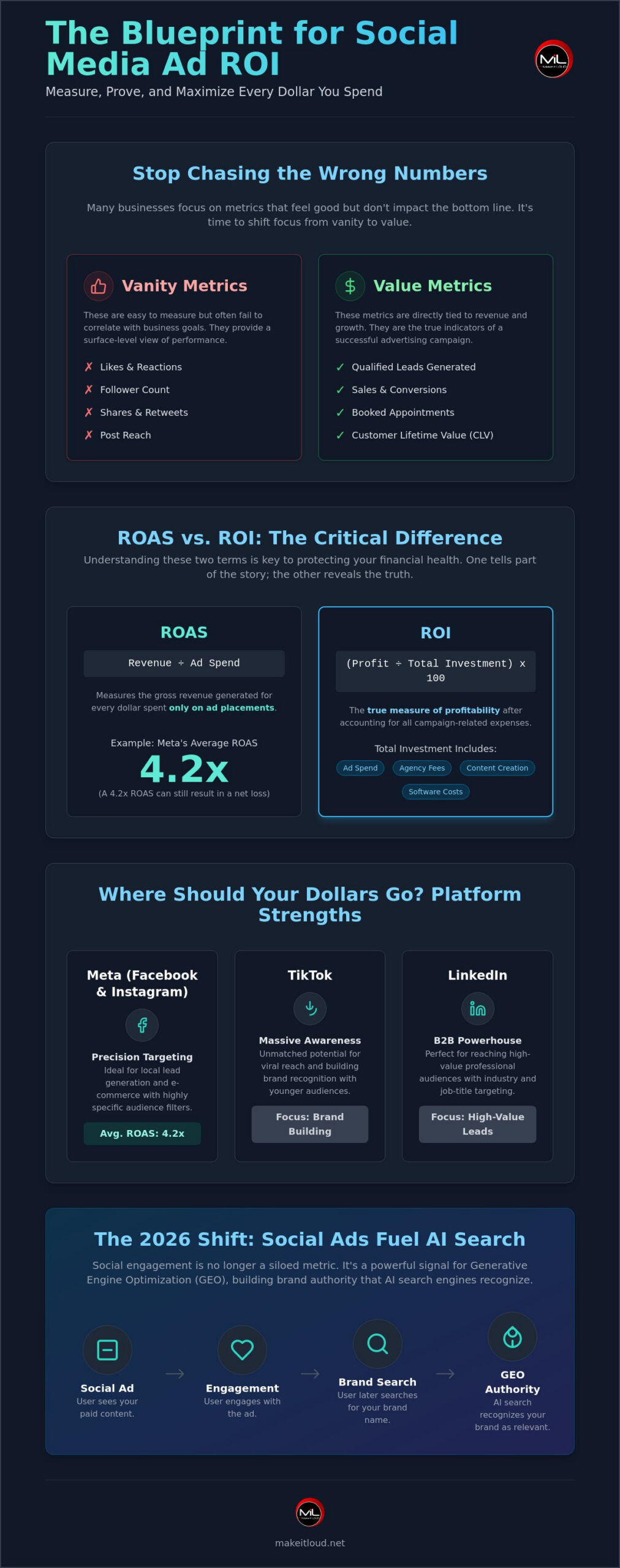
Likes don’t pay the mortgage. If your marketing reports are filled with engagement metrics while your bank account remains stagnant, you have a measurement problem. At its core, social media advertising roi is the measure of efficiency for every dollar you pull from your business and put into a paid social platform. It isn’t a “feeling” or a “brand awareness” score. It’s a hard financial calculation. To understand the true efficiency of your campaigns, you need to look at your Return on Marketing Investment (ROMI), which serves as the foundation for calculating your specific social returns.
The biggest trap for business owners is confusing vanity metrics with value metrics. Vanity metrics like follows, likes, and shares are easy to get. They make you feel good, but they don’t always correlate with growth. Value metrics are different. We’re talking about leads, sales, and booked appointments. If you’re clicking that “Boost Post” button on Facebook, you’re likely feeding the vanity beast. That button is designed for engagement, not conversion. It’s the slot machine of social media; it feels like you’re playing the game, but the house usually wins. A positive social media advertising roi requires a structured campaign built in the back-end ad manager, not a quick click on a shiny blue button.
Attribution in 2026 is also more complex than ever. A customer might see your Instagram ad on Monday, read a review on Wednesday, and finally buy through a Google search on Friday. If you only look at immediate clicks, you’ll miss the true impact of your spend. We look at wider attribution windows to see how social ads initiate the customer journey, even if they don’t always finish it.
ROAS vs. ROI: Knowing the Difference
Many agencies use these terms interchangeably. They shouldn’t. Return on Ad Spend (ROAS) measures gross revenue generated per dollar spent specifically on ads. For example, the average ROAS on Meta platforms in 2026 is 4.2x. However, ROI is the real truth-teller. ROI accounts for your ad spend plus agency fees, software costs, and content production. A 4x ROAS sounds great until you realize that after paying for the video shoot and the management fee, your business actually lost money. We prioritize the ROI because it protects your financial health.
The 2026 Shift: Social Ads as a GEO Signal
The landscape changed this year. Social engagement is no longer a siloed metric; it now influences Generative Engine Optimization (GEO). When users engage with your paid content, it builds brand authority that AI search engines recognize. This creates a “brand search” effect. People see your ad, and then they specifically search for your business name later. This synergy between social ads and AI-driven search results is how modern brands win. To fully understand how AI is reshaping the way customers find businesses, our guide on AEO vs SEO in the AI search era explains exactly how to position your brand for both traditional and AI-generated results. You aren’t just buying a click; you’re buying authority in a crowded digital market.
The Math That Matters: Calculating Your Return on Investment
Math is the antidote to marketing anxiety. To get an honest look at your social media advertising roi, you must move beyond the basic “spend versus revenue” mindset. The formula is straightforward: (Gains from Investment – Cost of Investment) / Cost of Investment. However, the cost of investment isn’t just your credit card charge from Meta or TikTok. It includes your content creation costs, agency management fees, and the software subscriptions used to run the campaigns. If you ignore these “hidden” expenses, your calculation is a fiction. You’re effectively lying to yourself about the health of your business.
Before you launch, you must identify your break-even point. How many leads do you need to cover the total cost of the campaign? This requires a deep understanding of your Customer Lifetime Value (CLV). A single transaction might look like a loss on day one; however, if that customer returns for five years, the social media advertising roi is massive. Our team specializes in social media advertising that prioritizes these long-term financial health metrics over temporary spikes in traffic. We want you to see the full picture, not just a snapshot of a single sale.
Tracking Tools for Honest Data
Honest data requires professional-grade tracking tools. The standard browser-based Pixel is no longer enough in 2026. You need server-side tracking and the Conversions API (CAPI) to capture data that ad blockers and privacy updates often miss. Combine this with strict UTM parameters for your GA4 reporting to ensure you know exactly which ad triggered which lead. When comparing social media platform ROI, these technical layers ensure you’re looking at facts, not guesses. You can also integrate AI-powered customer service tools to instantly grade lead quality. This prevents your budget from being eaten by low-intent “junk” form fills that waste your sales team’s time.
Identifying Your Core KPIs
Finally, you must distinguish between your CPL (Cost Per Lead) and your CPA (Cost Per Acquisition). For Atlanta service businesses, CPL is the most critical metric because it determines the volume of local opportunities entering your sales pipeline before they ever reach a closing table. While engagement rates are a helpful leading indicator, they’re only useful if they eventually drive down your CPA. Keep your eyes on the bank account, not the notification bell. Results-driven marketing is about efficiency; it’s about making sure every dollar has a job to do. If a campaign isn’t moving the needle on your CPA after an appropriate testing phase, it’s time to be honest and pivot.
Comparing ROI Across Platforms: Where Should Your Dollars Go?
Platform selection is not a guessing game. While some agencies claim TikTok is only for awareness or Meta is only for older demographics, the reality of 2026 is far more nuanced. Your social media advertising roi depends entirely on platform-product fit. For example, B2B marketers now rank LinkedIn as their most important channel, with 51% prioritizing it despite a higher average CPC of $6 to $12. Conversely, TikTok offers an underpriced average CPM of around $3.50. This makes it an efficiency powerhouse for brands like MG Affiliate Store that can master native video creative and reach a massive audience at a lower entry cost.
Don’t view these platforms in isolation. There is a powerful cross-channel effect where social ads directly improve your Google Adwords performance. When potential customers see your brand on their feed, they’re significantly more likely to click your search ad later. If you’re trying to decide where to allocate your next marketing dollar, understanding the full picture of social media advertising vs Google Ads is essential to making a confident, data-driven decision. This synergy also feeds your Generative Engine Optimization (GEO). AI search engines look for these social signals to verify your brand’s authority and relevance in real-time. By running coordinated campaigns across three or more platforms, you can see a 25% to 35% better performance than single-platform strategies.
The Local Advantage in Atlanta
National strategies often fail in local markets because they lack specificity. To maximize your return, you need Atlanta social media advertising services that understand the nuances of our neighborhoods. Targeting “Atlanta” as a single block is a recipe for wasted spend. We target specific pockets like Buckhead, Midtown, or Alpharetta and use local landmarks in our creative assets. This local relevance stops the scroll and builds immediate trust that a national, generic ad simply cannot replicate.
Platform-Specific ROI Benchmarks
What constitutes a “good” return? On average, well-run campaigns in 2026 see a 420% ROI, returning approximately $5.20 for every dollar spent. However, you must adjust your expectations based on your industry’s average buying cycle. A high-ticket professional service will have a longer lead-to-sale time than a retail product. Avoid the trap of comparing your results to generic industry averages found on surface-level blogs. Your data is unique to your business. We focus on your specific break-even points to ensure every campaign is grounded in your actual financial reality.
How to Fix a Tanking Social ROI: 5 Proven Strategies
Data doesn’t lie, but it can be painful to read. If your social media advertising roi has taken a dive, you don’t need a bigger budget; you need a better strategy. Most “failing” campaigns aren’t actually failures of the platform. They are failures of alignment. Before you pull the plug on your spend, look at these five areas where profit usually leaks out of a campaign. Start with your creative hook. If your ad doesn’t stop the scroll within the first 1.5 seconds, the rest of your funnel doesn’t matter. You’re paying for impressions that nobody is actually seeing.
Next, stop relying on broad interest targeting. While AI-powered tools like Meta’s Advantage+ have improved, they still need high-intent data to learn. Shift your focus toward lookalike audiences built from your actual customer lists or high-value website visitors. Combine this with a landing page audit. If you’re sending social traffic to a generic homepage, you’re wasting money. Social users have short attention spans. They need a fast-loading, dedicated page that mirrors exactly what the ad promised. A well-executed Hoschton GA web design strategy ensures your landing pages are built to convert, not just to look good. Finally, implement a strict A/B testing framework and fix your lead follow-up. The number one ROI killer isn’t the ad; it’s a sales team that takes four hours to call a lead that expected a response in four minutes.
Aligning Ads with Your Buying Cycle
High-ticket services don’t sell on the first click. If you’re selling a complex solution, a standard 30-day attribution window might make your ads look like they’re underperforming. You need retargeting sequences that nurture prospects over weeks, providing value and building authority before asking for the sale. This is especially true for localized growth. By integrating marietta social media marketing tactics, you can build deep-rooted local trust that national competitors can’t touch. We focus on the long game because that’s where the real profit lives.
Creative That Converts in 2026
The era of over-produced, “slick” commercials is over. In 2026, users crave authenticity. “Lo-Fi” content and user-generated content (UGC) consistently outperform high-budget productions because they feel native to the platform. You can use AI to personalize copy for different segments, but the visual must remain human. Video testimonials serve as the highest-ROI ad format for service businesses because they transform abstract promises into verifiable social proof that overcomes prospect skepticism instantly. If you’re ready to stop the guesswork and start scaling, let’s audit your current social strategy to find your hidden profit margins.
Why a Social Media Advertising Company is Your Best ROI Bet
Managing your own social campaigns is often a full-time job you never applied for. In the 2026 landscape, the technical requirements for success have moved beyond simple post scheduling. You need a partner who understands how social signals feed into your broader SEO and GEO strategies. As the line between traditional search and AI-generated answers continues to blur, understanding the evolving relationship between AEO vs SEO is critical to ensuring your social campaigns contribute to long-term brand visibility. A professional social media advertising company doesn’t just buy ads; they protect your capital. We take a straight-shooter approach to your budget. This means we have the seasoned confidence to tell you when a platform isn’t working or when it’s time to stop spending on a campaign that has hit a ceiling. Honesty is the only way to build a long-term partnership.
Professional management pays for itself through sheer efficiency. When you work with a locally-rooted partner who understands the Atlanta business climate, you aren’t paying for a learning curve. We already know which neighborhoods convert and which creative hooks resonate with local sensibilities. By eliminating wasted spend on low-intent audiences and optimizing your bidding strategies in real-time, we often find that the savings in ad spend more than cover our management fees. You get better results for a lower total cost of acquisition. It’s about working smarter, not just spending more.
Transparency and Reporting
An honest social media advertising roi report shouldn’t require a degree in data science to decode. If your current agency hides behind “impressions,” “reach,” or “estimated ad recall,” they’re dodging the real question: Did this make you money? Our philosophy is simple. We focus on the results you can see in your bank account. A transparent report clearly shows your total investment, the number of high-quality leads generated, and the ultimate cost per acquisition. We want you to feel the same confidence in your marketing data that you feel when looking at your monthly P&L statement.
Getting Started with a Proven Partner
The path to a better return starts with a comprehensive audit. We look at your historical data to find the “leaks” in your funnel where potential profit is escaping. For those just beginning their journey, we often integrate our social strategies with new business startup consulting. This ensures your brand is built on a foundation of high-converting web design and clear market positioning from day one. You don’t have to navigate this digital landscape alone. If you’re ready to make some noise and see a real impact on your bottom line, contact Make It Loud for a strategy session today. Let’s build a framework that works as hard as you do.
Turning Your Marketing Data Into Business Growth
Social media advertising shouldn’t be a gamble. By shifting your focus from vanity metrics to hard value metrics, you’ve already taken the first step toward a more profitable 2026. Success requires a balance of technical precision, native creative, and a deep understanding of your specific buying cycle. Whether you’re leveraging the precision of Meta or the high-volume awareness of TikTok, the goal remains the same. You need results that show up in your bank account, not just your notifications. Maximizing your social media advertising roi is a continuous process of auditing, testing, and refining. To scale these results into broader organizational success, you can learn more about Jani Havunen and his high-impact coaching for entrepreneurs.
We’ve spent over 20 years helping businesses navigate this evolving landscape. As a locally owned and operated partner in Atlanta, we specialize in high-ROI SEO and Social Sprints that deliver measurable progress. You deserve a partner who values transparency as much as you do. Stop guessing and start growing with a social media advertising company you can trust. The right strategy is waiting for you. Let’s get to work and build the sustainable growth your business deserves.
Frequently Asked Questions
What is a good social media advertising ROI for a small business?
A healthy benchmark for most service-based businesses in 2026 is a return between 250% and 500%. While the global average sits around 420%, your specific target depends on your profit margins and overhead. If you’re seeing a 4:1 return, or $4 in revenue for every $1 spent, you’re in a strong position to scale. Always measure against your net profit, not just gross revenue.
How long does it take to see a positive ROI from social ads?
You should plan for a testing phase of 30 to 90 days before expecting peak performance. Algorithms require time to identify your ideal customer, and your team needs data to refine creative hooks. While “quick wins” can happen in the first week, sustainable profitability usually arrives once the campaign has moved through the initial learning phase and audience seasoning.
Can I track social media ROI without expensive software?
Yes, you can track your social media advertising roi effectively using free tools like Google Analytics 4 (GA4) combined with strict UTM parameters. By tagging every ad link and setting up specific conversion events in GA4, you can see exactly which platforms are driving leads. You don’t need enterprise-level attribution platforms to get an honest look at your marketing math.
Why is my Facebook ad ROI lower than it used to be?
Increased competition and stricter privacy updates have made broad interest targeting less efficient than in previous years. Relying on the “Boost Post” button is now a recipe for wasted spend. To fix a declining return, you must shift toward high-intent lookalike audiences and implement server-side tracking. This ensures your data remains accurate despite browser-based ad blockers.
How much should I spend on social media ads to see a return?
Your budget should be determined by your Cost Per Acquisition (CPA) goals rather than a random monthly figure. A logical starting point is a budget that allows for at least 50 conversions per month. This provides the platform’s AI with enough data to optimize your delivery. If your target CPA is $20, a $1,000 monthly spend is a realistic entry point.
Does social media advertising help my SEO rankings?
Social ads don’t directly change your backlink profile, but they create a significant “brand search” effect that boosts your SEO and GEO authority. When users see your ads and later search for your business by name on Google, it signals to search engines that you’re a trusted entity. This increased search volume is a powerful indirect factor for higher rankings.
What is the most effective social media platform for ROI in 2026?
Meta remains the leader for local service targeting, but LinkedIn is the clear winner for B2B, with 51% of marketers prioritizing it. For brands seeking underpriced reach, TikTok offers an average CPM of $3.50. The “most effective” platform is always the one where your specific audience shows high intent. Most businesses find their best return by coordinating spend across three or more channels.
How do I know if my social media agency is being honest about ROI?
An honest agency will focus on leads and revenue in their reports rather than vanity metrics like impressions or reach. They should be able to show you the direct link between your social media advertising roi and your actual bank deposits. If they can’t explain the math or they hide their management fees from the total calculation, it’s time to seek a more transparent partner.