
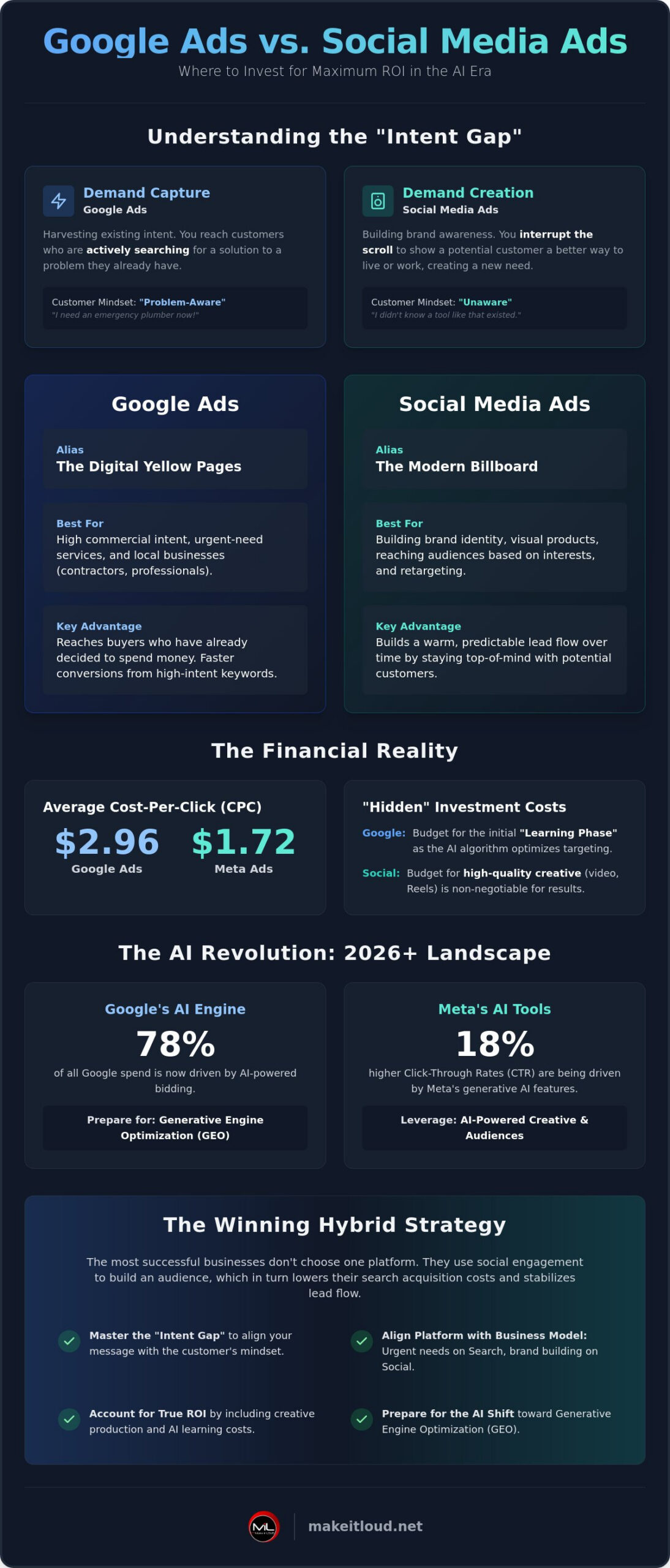
Where should you spend your first $1,000 this month to see a real return on investment? It’s a question we hear from business owners every week. You’ve likely felt the sting of a “boosted” post that generated likes but zero revenue, or watched your margins disappear as Google Ads cost-per-click rates rose to an average of $2.96. When weighing social media advertising vs google ads, the right choice isn’t about which platform is “better” in a general sense. It’s about where your specific customer is in their buying journey. Beyond advertising, you can learn more about optimizing your overall business and financial resources through MG Affiliate.
We agree that the current digital environment feels more complex than ever. With AI-powered bidding now driving 78 percent of all Google spend and new disclosure laws for synthetic content, the old playbooks are obsolete. This comparison provides the transparency you’ve been looking for. We’ll show you how to lower your customer acquisition costs and build a predictable lead flow. You’ll learn when to use Google to capture existing demand and when Meta’s generative AI tools, which are currently driving 18 percent higher click-through rates, are the better bet for building a brand from scratch.
Key Takeaways
- Master the “Intent Gap” to decide if you should be harvesting existing searches or interrupting the scroll to build brand awareness.
- Evaluate the true ROI of social media advertising vs google ads by accounting for 2026’s rising creative production costs and search competition.
- Align your platform priority with your business model, ensuring “Urgent Need” services don’t waste budget on low-intent social feeds.
- Prepare for the shift toward Generative Engine Optimization (GEO) as AI-powered summaries change how users interact with traditional ads.
- Implement a hybrid strategy that uses social engagement to lower your search acquisition costs and stabilize your lead flow.
Understanding the Intent Gap: Demand Capture vs. Demand Creation
Success in the digital advertising landscape depends on one factor: understanding why your customer is online. We call this the Intent Gap. When comparing social media advertising vs google ads, you aren’t just choosing a platform. You’re choosing a psychological strategy. Do you want to find people who are already looking for you, or do you want to convince people they need you? Most businesses fail because they try to use social media to capture search intent or use Google to build a brand from scratch. Both are expensive mistakes.
Demand Capture is the bread and butter of Google Search. It’s the act of harvesting existing intent. When a pipe bursts at 2:00 AM, that homeowner isn’t scrolling Instagram for aesthetic bathroom inspiration. They’re “Problem-Aware.” They need a solution now. Conversely, Demand Creation happens on social platforms. Here, you interrupt the scroll to build brand awareness among an “Unaware” audience. They didn’t know they needed your product until your ad showed them a better way to live or work. In 2026, the lines are blurring. Modern buyers are skeptical and research-heavy. They might see your ad on TikTok, search for your reviews on Google, and finally click a retargeting ad on Facebook. This multi-touch journey is why choosing between platforms is often a false dilemma. You need to meet them at every stage of their psychological journey.
Google Ads: The Digital Yellow Pages
Google Ads remains the most efficient way to reach customers with high commercial intent. For Atlanta contractors and professionals, being first in search isn’t a luxury; it’s a necessity. Local Services Ads (LSAs) are now the gold standard for local trust. They provide “Google Screened” badges that immediately separate pros from amateurs. You aren’t fighting for attention here. You’re simply answering a call that’s already been made. High-intent keywords lead to faster conversions because the buyer has already decided to spend money.
Social Media Ads: The Modern Billboard
Social media is where you build your visual identity. Platforms like Instagram and TikTok allow you to use demographic targeting to find ideal customers based on interests, even before they realize they have a problem. It’s proactive rather than reactive. The real power lies in retargeting. If a prospect visits your site but doesn’t buy, social ads keep you top-of-mind. This “Modern Billboard” approach ensures that when they’re finally ready to pull the trigger, your name is the only one they remember. It turns a cold audience into a warm, predictable lead flow over time.
The Financial Reality: Comparing Costs and ROI in 2026
How much should you actually spend? It’s the most common point of friction we see with new clients. When comparing social media advertising vs google ads, the financial math changes based on how you pay for attention. Google typically operates on a Cost-Per-Click (CPC) model. You only pay when someone shows interest. Social media often leans toward Cost-Per-Thousand-Impressions (CPM), though CPC options exist. In 2026, Google Search clicks average $2.96, while Meta platforms sit around $1.72. These numbers don’t tell the whole story, though. You must account for the initial “Learning Phase.” This is the period where AI algorithms test your ads against different audiences. It often feels like a loss, but it’s actually a necessary investment in data. Without this phase, your campaigns will never reach peak efficiency.
Social media requires a different kind of financial commitment. While the clicks might be cheaper, the creative production costs are higher. You can’t just run a static image and expect results in 2026. Video is the baseline. When planning your digital advertising budget, you must factor in the time or capital needed to produce high-quality Reels or TikTok-style content. If you ignore this “hidden cost,” your social media advertising roi will suffer before the first ad even goes live. You’re paying for attention, and in 2026, attention is expensive to earn.
Budgeting for Search: Quality Over Quantity
Google’s auction isn’t just for the highest bidder. It rewards relevance. A small, surgical budget focused on high-intent keywords often outperforms a massive, broad campaign. In competitive Georgia markets, your Quality Score is your best friend. It lowers your cost-per-acquisition by proving to Google that your landing page actually solves the user’s problem. If you need help refining your strategy, our team provides expert Google Adwords management to ensure every dollar works harder.
Budgeting for Social: The Cost of Attention
Social ads come with a “Trust Tax.” Because you’re interrupting someone’s day, it takes longer to convert a cold lead into a customer. You aren’t just paying for a click; you’re paying for the opportunity to start a relationship. This is why we focus on Lifetime Value (LTV). A customer acquired through social might cost more in creative effort, but they often become brand advocates if the experience is right. Video is no longer optional. It’s the only way to break through the noise and capture genuine attention in a distracted world.
Which Platform Wins for Your Specific Industry?
Choosing between social media advertising vs google ads isn’t a coin flip. It’s a strategic alignment with your specific business model. We categorize our clients into three main buckets: Urgent Need, Lifestyle, and B2B Professional. Each requires a different entry point to maximize profitability. If you’re a plumber or a lawyer, your customers are looking for you. If you sell boutique fitness apparel, you need to find them. This Google Ads vs. Facebook Ads comparison confirms that search dominates when a problem is immediate, while social wins when desire is visual.
Urgent Need businesses belong on Google. When a basement floods, no one checks Instagram for a plumber. They need a solution now. This high-intent traffic leads to a faster ROI because the decision to buy is already made. On the other hand, Lifestyle brands thrive on social media. E-commerce and fitness brands use visual storytelling to create a “need” where none existed. B2B firms require a hybrid approach. Decision-makers might discover you through a targeted social ad, but they’ll validate your authority through a Google search before signing a contract. You must be visible at both ends of the funnel to close high-value deals.
Local Services and the Search Advantage
Why do Atlanta homeowners turn to Google first for emergency repairs? It’s about proximity and immediate trust. Google Ads, especially when integrated with a robust Google Business Profile, provides instant geographic relevance. We’ve seen this play out with high-ticket service contracts. A local HVAC company recently secured a $15,000 commercial install simply because they were the first trusted result when a facility manager’s system failed. Search wins here because it captures the lead at the exact moment of crisis. It’s about being the answer to a specific, urgent question.
E-commerce and the Social Discovery Engine
E-commerce is shifting toward integrated shopping experiences. Meta and TikTok shops now allow users to purchase without ever leaving the app, significantly reducing friction. Our atlanta social media advertising services focus on scaling these brands by leveraging social proof. In 2026, user-generated content and real reviews are the primary currency of advertising. If your customers aren’t talking about you, your ads will struggle to perform. We use social discovery to turn browsers into buyers by showing your product in action, building a community before the first search even happens.
The New Variable: How AI and GEO are Changing the Ad Landscape
The conversation around social media advertising vs google ads has shifted. It’s no longer just about where you place your banner or which keyword you bid on. In 2026, the real battle is being fought within AI algorithms. We’ve entered the era of Generative Engine Optimization (GEO). Simply put, GEO is the optimization of content specifically for AI-driven responses. As AI-powered search summaries become the default, traditional click-through rates are changing. Users often find the answer they need directly in the search interface without ever visiting a website. This means your ads and your organic content must work together to ensure the AI “engine” recognizes your business as the definitive authority.
We’re seeing a massive shift from simple keyword matching to “entity and intent” matching. Google and Meta don’t just look for words; they look for the relationship between concepts and the user’s ultimate goal. To keep pace, businesses are turning to seo sprints to rapidly update their digital footprint. These sprints ensure your data is clean and your authority is established before you pour money into paid ads. If the AI doesn’t trust your site, your ad performance will suffer. It’s a holistic ecosystem now. Success requires a baseline of trust that the algorithm can verify across the web.
AI-Powered Targeting: Smarter, Not Harder
Modern platforms like Meta’s Advantage+ and Google’s Performance Max are incredibly powerful. AI-powered bidding now drives 78 percent of all Google Ads spend. These systems find buyers by analyzing billions of data points that a human could never process. However, there’s a danger in “Auto-Pilot” settings. While the AI is smart, it’s also hungry for budget. Without human oversight, these systems can chase low-quality traffic that looks good on paper but never converts. You need a partner who knows when to let the AI run and when to pull the reins. If you want to see how we handle this balance, check out our Google Adwords Management services.
The Future of Search: Ads in the Generative Era
Where do ads appear when there’s no traditional results page? We’re seeing them integrated directly into chat interfaces like ChatGPT, Perplexity, and Gemini. Your website must be “readable” by both humans and AI bots to stay relevant. This is why our hoschton ga web design team focuses on building conversion-ready, AI-friendly structures. If an AI bot can’t parse your service list or verify your location, you won’t appear in the generative summary. The goal is to be the brand the AI recommends, not just the one it summarizes. It’s about building a digital foundation that survives the shift to conversational search.
Beyond the Platform: Choosing the Right Strategy for Atlanta Businesses
The most successful campaigns we manage don’t treat social media advertising vs google ads as a binary choice. They use a hybrid approach. Social media builds the initial recognition, which lowers your cost-per-click on Google later. When a customer sees your brand on their feed and later searches for your service, they’re more likely to click your search ad because you’re already a familiar face. This synergy is how you stabilize lead flow and protect your margins. For businesses focusing on marietta social media marketing, this local relevance is your secret weapon. You aren’t just competing on a national level; you’re winning the trust of your neighbors through consistent, multi-channel visibility.
Honest marketing often means telling a client when not to spend. If your website doesn’t convert or your offer isn’t clear, pouring money into ads is just subsidizing a leaky bucket. We’ve seen business owners lose thousands because they followed a generic YouTube tutorial instead of building a strategy tailored to their specific market. A veteran partner will tell you the truth about your readiness. Sometimes, you need to fix your foundation before you touch the “boost” button. Strategy always precedes spend. If you’re just starting out, our new business startup consulting can help you build that roadmap from day one.
What to Look for in a Digital Partner
The industry is full of flashy promises. How do you spot a straight shooter? Look for transparency. If an agency guarantees a specific ROI or hides behind “proprietary” secrets, walk away. You should have full access to your own ad dashboards and clear, monthly reporting that focuses on profit, not just “vanity metrics” like likes or impressions. A real partner prioritizes your financial health over their own management fees. They should act as a proactive guide, navigating the complex social media advertising vs google ads landscape so you can focus on running your business.
Your 2026 Ad Roadmap
Stop guessing and start measuring. Follow these three steps to launch with confidence:
- Step 1: Audit your conversion rate. Check your website analytics. If your site doesn’t turn current visitors into leads, ads won’t fix it.
- Step 2: Define your primary goal. Are you hunting for immediate leads (Google) or building a long-term brand (Social)? You can’t do both effectively on a shoestring budget.
- Step 3: Launch a pilot. Commit to a 90-day window with clear KPIs. This gives the AI enough time to move through the learning phase and produce reliable data.
Ready to see which strategy fits your business model? We’re here to provide the clarity you need to grow. Let’s discuss your goals and build a predictable lead flow together.
Secure Your Competitive Advantage in 2026
The choice between social media advertising vs google ads is no longer a simple platform preference. It’s a strategic decision based on your customer’s psychological state and your specific business model. You now understand that Google captures immediate intent while social media builds the awareness that fuels future searches. In a 2026 landscape defined by AI summaries and Generative Engine Optimization, having a static strategy is the fastest way to lose market share. You need a dynamic approach that connects these channels into a single, high-performing ecosystem.
Make It Loud is a locally owned Atlanta agency with over 20 years of digital marketing expertise. We offer the red-flag-free transparency you deserve, ensuring you always own your data and understand your real ROI. We don’t hide behind jargon or proprietary secrets; we focus on tangible outcomes that protect your bottom line. Stop wondering where your next lead is coming from. Stop wasting ad spend and get an honest strategy from Make It Loud. Your business deserves a partner who is as committed to your financial success as you are.
Frequently Asked Questions
Which is better for small businesses: Facebook or Google Ads?
The better platform depends entirely on your business model and whether you need to capture existing demand or create it. Google Ads is the superior choice for service providers like plumbers or locksmiths because it targets users with immediate, urgent needs. Facebook is more effective for lifestyle brands or new products that rely on visual discovery and interest-based targeting to build an audience from scratch.
How much should a small business spend on digital advertising in 2026?
Small businesses should base their budget on their target cost-per-acquisition rather than a generic industry percentage. In 2026, the average cost-per-click on Google Search is $2.96, while Meta platforms average $1.72. We recommend starting with a budget that allows for at least 100 to 200 clicks per month. This provides enough data to move through the initial learning phase and identify which keywords or audiences actually drive profit.
Do social media ads help my Google search ranking?
Social media ads don’t directly improve your organic search rankings, but they do influence them indirectly. When people see your ads on Instagram or TikTok, they often perform a branded search on Google later to check your reviews. This increase in branded search volume signals to Google that your business is an authority in your field. It’s a key reason why the debate of social media advertising vs google ads often ends in a hybrid strategy.
Can I run Google Ads without a website?
You can technically run certain types of ads without a traditional website, but it’s rarely the most profitable strategy. Google’s Local Services Ads and lead form extensions allow you to capture calls and emails directly within the search interface. However, a dedicated landing page typically converts at a higher rate. Without a site, you lose the ability to retarget visitors or provide the deep-level trust that modern consumers expect before buying.
What is the average ROI for social media marketing in Atlanta?
Average ROI for social media marketing in Atlanta is highly dependent on your industry’s lifetime customer value and your creative quality. Businesses using Meta’s generative AI tools are currently seeing an 18 percent higher click-through rate compared to traditional static ads. Success in the local market requires a focus on high-quality video content. If your creative doesn’t stop the scroll, your return on investment will struggle regardless of your targeting settings.
Is Google Ads better for B2B or B2C companies?
Google Ads is highly effective for both B2B and B2C companies because it targets intent rather than just demographics. B2C companies use it to capture immediate sales, while B2B firms use it to find decision-makers who are actively researching professional services. Because B2B sales cycles are longer, Google Ads serves as a critical touchpoint to ensure your firm is visible at the exact moment a potential client begins their procurement process.
How do top social media marketing agencies measure success?
Top social media marketing agencies measure success through tangible financial returns and cost-per-acquisition (CPA) rather than vanity metrics. Likes, shares, and impressions are leading indicators, but they don’t pay the bills. A veteran agency will focus on how many qualified leads or sales were generated per dollar spent. They should provide a transparent dashboard that connects your ad spend directly to your bottom line, ensuring every campaign is a profitable investment.
What happens if I stop my ads? Will my organic traffic drop?
Stopping your ads won’t cause your organic search rankings to drop, but you’ll see an immediate decrease in your total lead volume. Paid ads and organic SEO operate on different systems. However, many businesses notice a “halo effect” where total brand awareness dips when ads are turned off. When comparing social media advertising vs google ads, remember that ads provide a predictable flow while organic growth takes time to build and maintain.