

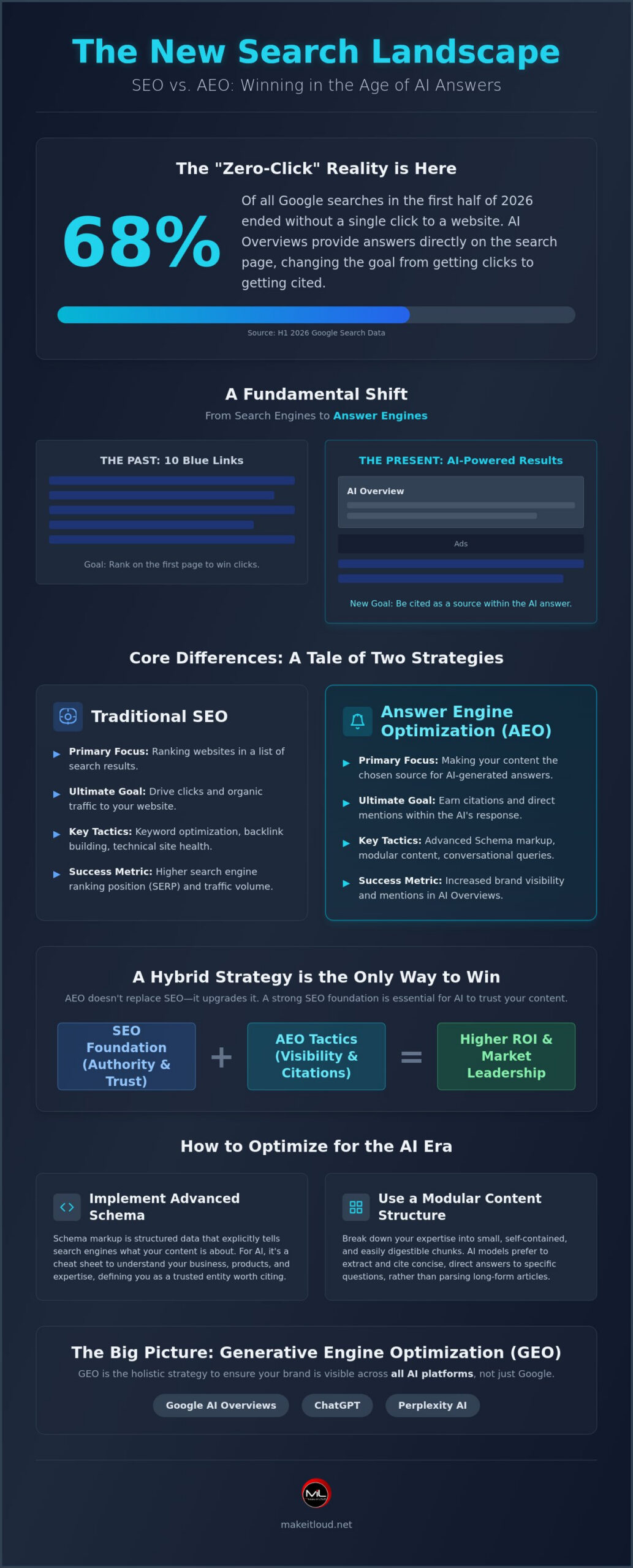
Did you know that 68% of all Google searches in the first half of 2026 ended without a single click to a website? If you feel like you’re fighting a losing battle against AI Overviews, you aren’t alone. The traditional search landscape has shifted, forcing a direct confrontation between aeo vs seo. Many business owners fear their current marketing budget is being poured into a dying strategy. We understand that frustration. It’s hard to stay confident when the rules of the game change every few months.
You don’t have to choose one over the other to stay relevant. This guide provides an honest look at how to win in the AI era. We’ll show you exactly how to protect your current rankings while positioning your brand as the top choice for AI-generated answers. You will gain a clear understanding of the new landscape and learn how to build a hybrid strategy that delivers a higher ROI from your digital spend. It’s time to stop guessing and start capturing the mentions your business deserves.
Key Takeaways
- AI search has shifted the focus from website clicks to direct citations, requiring a new approach to remain visible in 2026.
- Master the core differences in aeo vs seo to ensure your brand appears in both traditional search results and AI-generated answers.
- Implementing advanced Schema Markup is the most effective way to define your business as a trusted entity for generative models.
- A hybrid marketing strategy is essential to protect your current organic traffic while capturing a larger share of AI mentions.
- Learn why modular content structure is the key to having your expertise extracted and cited by platforms like ChatGPT and Perplexity.
The Death of the 10 Blue Links? Why Search is Changing in 2026
For decades, the goal of digital marketing was simple. You fought for a spot in the “10 blue links” on the first page of Google. If you ranked high, you got the traffic. But the game board has been flipped. In the first half of 2026, data showed that 68% of all Google searches ended without a single click to a website. This is the “zero-click” reality. Google’s AI Overviews, powered by the Gemini family of models, now appear in nearly half of all US search results. They provide the answer directly on the screen, often removing the need for a user to visit your site at all.
We are witnessing a fundamental shift from “Search Engines” to “Answer Engines.” Platforms like ChatGPT, which now reaches 900 million weekly active users, and Perplexity AI are changing how people find information. They don’t just point to pages; they synthesize facts. This evolution has created a divide in strategy: aeo vs seo. While traditional Search engine optimization (SEO) focuses on ranking your website in a list, Answer Engine Optimization (AEO) is the process of making your content the chosen answer that the AI actually speaks or displays. It’s about being the source of the information, not just a destination for a click.
From Keywords to Conversations
User behavior has moved away from typing fragmented keywords. People now ask complex, multi-part questions. They use voice search while driving or type full sentences into AI assistants. Traditional keyword stuffing has become a liability in this environment. If your content doesn’t provide a direct, concise solution to a specific problem, the AI will simply skip over you. Modern search is a dialogue, and your brand needs to be a helpful participant in that conversation to stay relevant.
The New Search Hierarchy
Look at a search results page today. AI-generated summaries sit at the very top, followed by ads, and then the traditional organic links. These organic links are being pushed further down the “fold,” making them harder for users to find. Success in 2026 requires more than just a high ranking; it requires being cited as a trusted source within the AI’s response itself. AEO is the science of earning AI citations to ensure your brand remains the authority in your industry. You don’t need to abandon your old strategies, but you must evolve them to survive this new hierarchy.
Defining the Players: SEO, AEO, and the Rise of GEO
Jargon is the enemy of progress. In the digital marketing world, new acronyms pop up every week. For a business owner, this usually sounds like another reason to raise your monthly retainer. Let’s cut through the noise. To win in 2026, you must understand three distinct pillars. SEO is your veteran foundation. It focuses on rankings, site speed, and backlinks. It’s about being the best destination on the map. AEO is the specialized branch focused on providing direct, concise answers. It’s about being the answer itself.
When evaluating aeo vs seo, it’s easy to get lost in the technical weeds. Then there is GEO. Generative Engine Optimization is the holistic approach to ranking in generative AI environments like ChatGPT and Perplexity. For Atlanta businesses, distinguishing between these isn’t just an academic exercise. It’s about budget allocation. If you spend 100% of your budget on traditional SEO, you’re ignoring the majority of users who never leave the search page. You need to know which tool to use for which job.
Is AEO Replacing SEO?
The short answer is no. It is a sophisticated upgrade to your existing foundation. Think of SEO as the engine of your car and AEO as the high-performance fuel. You cannot have successful AEO without a technically sound SEO base. If your site is slow or lacks authority, AI models won’t trust your content enough to cite it. You need an ROI Driven SEO Strategy to ensure the foundation is strong before you try to capture AI mentions. One builds the house; the other makes sure people can find the front door.
What is Generative Engine Optimization (GEO)?
GEO bridges the gap between traditional ranking and AI mentions. It ensures your brand is visible across all AI platforms, not just Google. The 2026 reality is simple. Search is now a hybrid of traditional algorithms and Large Language Models (LLMs). Understanding the Core Differences & How to Win Visibility is the first step toward a modern strategy. If you want to dive deeper into the technical side, check out our full guide on Generative Engine Optimization (GEO): The 2026 Guide to AI Search. If you aren’t sure where your current strategy stands, it might be time to talk to a veteran team that has seen these shifts before.
AEO vs SEO: Breaking Down the Core Differences
Understanding the technical nuances of aeo vs seo is the only way to protect your marketing ROI in 2026. The finish line has moved. In traditional SEO, the goal is simple: capture the click. You want users to land on your website so you can convert them. In AEO, the goal is brand imprinting. You want the AI model to cite your business as the definitive authority. This shift changes everything from how you write content to how you measure success.
Content structure is the most visible difference. Traditional SEO often rewards long-form, comprehensive guides that keep users on the page. AEO demands modular, structured data. AI models don’t want to read a 3,000-word essay to find a single fact. They look for “bite-sized” chunks of information that are easy to synthesize into a summary. While SEO relies heavily on backlinks to build authority, AEO prioritizes entity-based trust. It looks at how often your brand is mentioned across the web as a reliable source, regardless of whether there’s a direct link involved.
Measuring What Matters in 2026
Ranking #1 is no longer the only metric for success. If an AI Overview answers the query before the user scrolls, that top organic spot loses its value. You need to track your “AI Visibility Score” and your brand’s share of voice within LLM responses. Citation count has become the new high-value lead indicator. By focusing on AI visibility strategy and brand citation management, ZeroClick.sg helps businesses adapt to this change. We now track how often brands appear in Perplexity and ChatGPT results to gauge true market influence. If the AI isn’t mentioning you, you’re invisible to a massive segment of your audience.
The Intent Divide
SEO still dominates for navigational and transactional intent. If someone is looking for your specific login page or wants to buy a product right now, they’ll likely click a link. However, AEO is the ultimate tool for informational and comparative intent. Users asking “What is the best way to…” or “Compare X vs Y” are looking for answers, not a list of websites to browse. AEO builds trust by providing immediate value before the user ever clicks a link. By appearing as the cited source in an AI answer, you establish authority at the very start of the customer journey. This ensures that when they are finally ready to buy, your name is already the one they trust.
How to Optimize for the AI Era Without Losing SEO Rankings
You don’t have to sacrifice your current traffic to prepare for the future. The debate of aeo vs seo isn’t about choosing sides. It’s about layering your strategy. You can maintain your traditional rankings while ensuring AI models can easily digest and cite your expertise. This requires a shift in how you present information. It moves your site from being a simple billboard to becoming a structured database that AI engines trust.
Step 1: Implement advanced Schema Markup. This defines your business as an “Entity” rather than just a collection of keywords. Step 2: Restructure your content. Move away from long intros and get straight to the point. Step 3: Build authority with unique data. AI prizes original insights that can’t be found elsewhere. Step 4: Polish your Google Business Profile. This remains the primary source for local AI discovery in 2026.
The Power of Structured Data
Schema.org is the language AI engines use to understand your site. Without it, you are leaving your brand’s reputation up to chance. Specific types of schema, like LocalBusiness, Review, and FAQ, are essential for every Atlanta company. This structured data reduces the hallucination risk. When you tell the AI exactly what your services are through code, it’s less likely to invent incorrect information about your brand. It provides a steady, reliable source of truth for Gemini and ChatGPT alike.
Modular Content Strategy
Adopt the “Inverted Pyramid” for AEO. This means putting the direct answer to a user’s question in the very first paragraph of your sections. Use your H2 and H3 headings as direct questions. For example, “How does SEO work in 2026?” is more effective than a generic heading like “SEO Overview.” This structure triggers featured snippets and makes it easy for AI to extract citations. If you need to modernize your site quickly, our SEO Sprints are designed to implement these technical changes in weeks, not months.
You deserve a strategy that works for both humans and machines. Don’t wait for your traffic to drop before you take action. Schedule a consultation with our veteran team to see how we can protect your rankings while capturing the AI market.
Why a Hybrid Strategy is the Only Way to Win in Atlanta
Choosing between aeo vs seo is a false dilemma that could cost your business its competitive edge. If you go all-in on AEO, you might get mentioned by an AI assistant, but you’ll likely lose the high-intent, conversion-ready traffic that traditional search still delivers. SEO is what puts your phone number in front of someone ready to buy right now. AEO is what builds the long-term trust that makes them choose you over a competitor. You need both to own the screen in 2026.
At Make It Loud, we’ve been helping businesses grow since 2004. We’ve seen every “major” industry shift, and our philosophy remains the same: focus on the client’s financial health. We use a veteran SEO foundation as the bedrock, then layer a GEO amplifier on top. This hybrid approach ensures you dominate the “Map Pack” for local buyers while simultaneously appearing in the “AI Overview” for those in the research phase. It’s about being present at every stage of the modern customer journey.
Local Search in the AI Age
Local businesses in Atlanta face a unique challenge. AI models like Perplexity and ChatGPT aren’t just reading your website content. They are actively scraping Google Maps data and local review sites to recommend services. Your reputation is no longer just a tool for social proof; it’s a primary data point for generative engines. If the AI sees a pattern of high-quality reviews and consistent local citations, it’s far more likely to recommend you as the top local expert. To handle the influx of these new leads, many forward-thinking firms are now integrating AI Customer Service in Atlanta to ensure no prospect falls through the cracks.
Future-Proofing Your Digital Presence
Search diversity is your best defense against an unpredictable digital landscape. Putting all your eggs in one basket is a recipe for disaster. If Google changes its AI layout tomorrow, a hybrid strategy ensures your business doesn’t disappear overnight. You need a campaign that is GEO-ready from day one, focusing on structured data, modular content, and authoritative brand mentions. We don’t just chase rankings; we build digital assets that produce measurable results. Ready to dominate search and AI? Contact Make It Loud for a 2026 strategy session.
Secure Your Digital Future in the AI Era
The shift in aeo vs seo is no longer a prediction; it’s a reality business owners must face today. We’ve established that success in 2026 requires a hybrid approach. This strategy protects your traditional organic traffic while winning citations in AI-generated answers. By implementing structured data and modular content, you position your brand as the definitive authority that generative engines trust. You don’t have to navigate these technical changes alone.
Make It Loud is a veteran agency founded in 2004. We are locally owned and operated in Atlanta, providing specialized GEO and AI integration services designed to produce tangible financial outcomes. We’ve seen the industry evolve for over two decades, and we know exactly what it takes to stay visible. Don’t let your business fall behind as the search landscape shifts.
Get a Free SEO & GEO Strategy Audit for Your Atlanta Business
The rules of engagement have changed, but your growth doesn’t have to stall. Let’s build a stable, results-driven strategy that works for the modern world. We are ready to help you dominate both the search results and the AI answers.
Frequently Asked Questions
Will AEO replace SEO entirely by 2027?
No, AEO will not replace SEO. They are two parts of a single engine. While AEO captures informational queries and “brand imprinting,” traditional SEO remains essential for driving transactional traffic and direct conversions. You still need a website that ranks in blue links to capture users who are ready to buy. The debate of aeo vs seo is about integration, not replacement.
What is the main difference between AEO and GEO?
AEO focuses specifically on providing the direct, concise answer to a user’s query. GEO, or Generative Engine Optimization, is the broader practice of optimizing your entire digital footprint for models like ChatGPT and Perplexity. Think of AEO as the “what” (the answer itself) and GEO as the “how” (the overall strategy to be visible across AI platforms).
Do I need to rewrite all my website content for AI search?
You don’t need a total rewrite. Focus on restructuring your most important pages into a modular format instead. AI models prioritize content that is direct and easy to parse. By moving your answers to the top of the page and using clear headings, you make your existing expertise more “AI-friendly” without starting your content strategy from scratch.
How do I track if ChatGPT or Perplexity is citing my business?
Tracking citations requires looking beyond traditional traffic logs. You can monitor brand mentions in AI responses using specialized tracking tools or by manually auditing top queries for your industry. Success is now measured by “Share of Model” rather than just clicks. Traffic from AI sources often converts 42% better, making these citations highly valuable for your ROI.
Is AEO more expensive than traditional SEO services?
AEO isn’t necessarily more expensive; it’s a shift in where your budget is allocated. It involves more technical work, such as advanced Schema implementation and content restructuring. Most veteran agencies now integrate these strategies into their modern service packages. It is an investment in long-term brand security rather than a separate, unrelated cost.
Can a local Atlanta business benefit from AEO?
Absolutely. Local Atlanta businesses benefit through “local AI discovery.” When a user asks an AI assistant for a local recommendation, the model scrapes Google Business Profiles and local reviews. If your business is cited as the top answer, you build immediate trust. This is a powerful way to stay ahead of local competitors who only focus on traditional map rankings.
What tools should I use to monitor my AI search visibility?
You should use a mix of traditional and modern tools. Google Search Console provides data on AI Overviews, while new platforms are emerging to track visibility in Perplexity and ChatGPT. Manual audits of your primary keywords remain the most reliable way to see exactly how AI models are presenting your brand to potential customers in 2026.
How does structured data (Schema) help with AI search results?
Structured data acts as the “language” that AI models use to understand your site. By using Schema markup, you provide clear, factual data that reduces the risk of AI “hallucinations.” This ensures the models have the correct information about your services, location, and expertise. It makes them far more likely to cite you as a trusted source in their generated answers.