

Why are you still paying $250 for a single SaaS lead while your competitors are being cited for free by ChatGPT and Perplexity? It’s a valid question that many technical founders are asking as traditional ad platforms become increasingly crowded and expensive. You’ve likely noticed that generic digital marketing for tech companies often fails because it lacks the depth your product requires. High cost-per-acquisition and agencies that can’t tell a container from a codebase are the norm, but they shouldn’t be.
We understand that you need more than just traffic; you need a predictable lead flow that recognizes your technical nuances. This guide promises to move you beyond the basics and into the 2026 Growth Framework. We will show you how to transition from traditional SEO to AI-driven discovery through Generative Engine Optimization (GEO). We are covering everything from slashing your CPA to becoming the cited authority in AI-generated answers, giving you a marketing strategy that finally speaks your language and respects your bottom line.
Key Takeaways
- Avoid the “Jargon Trap” and learn how to align your digital marketing for tech companies with the way modern buyers actually search.
- Master Generative Engine Optimization (GEO) to ensure your technical documentation becomes a primary source for AI-driven answer engines.
- Implement 90-day SEO Sprints to bypass the traditional 12-month wait for organic traction and generate predictable lead flow faster.
- Apply the “3-Second Rule” to your web design to turn complex technical specs into high-converting sales assets.
- Understand why transparency and straight talk from a veteran partner are more valuable than flashy promises in the evolving 2026 landscape.
The Tech Marketing Paradox: Why Traditional Strategies Fail in 2026
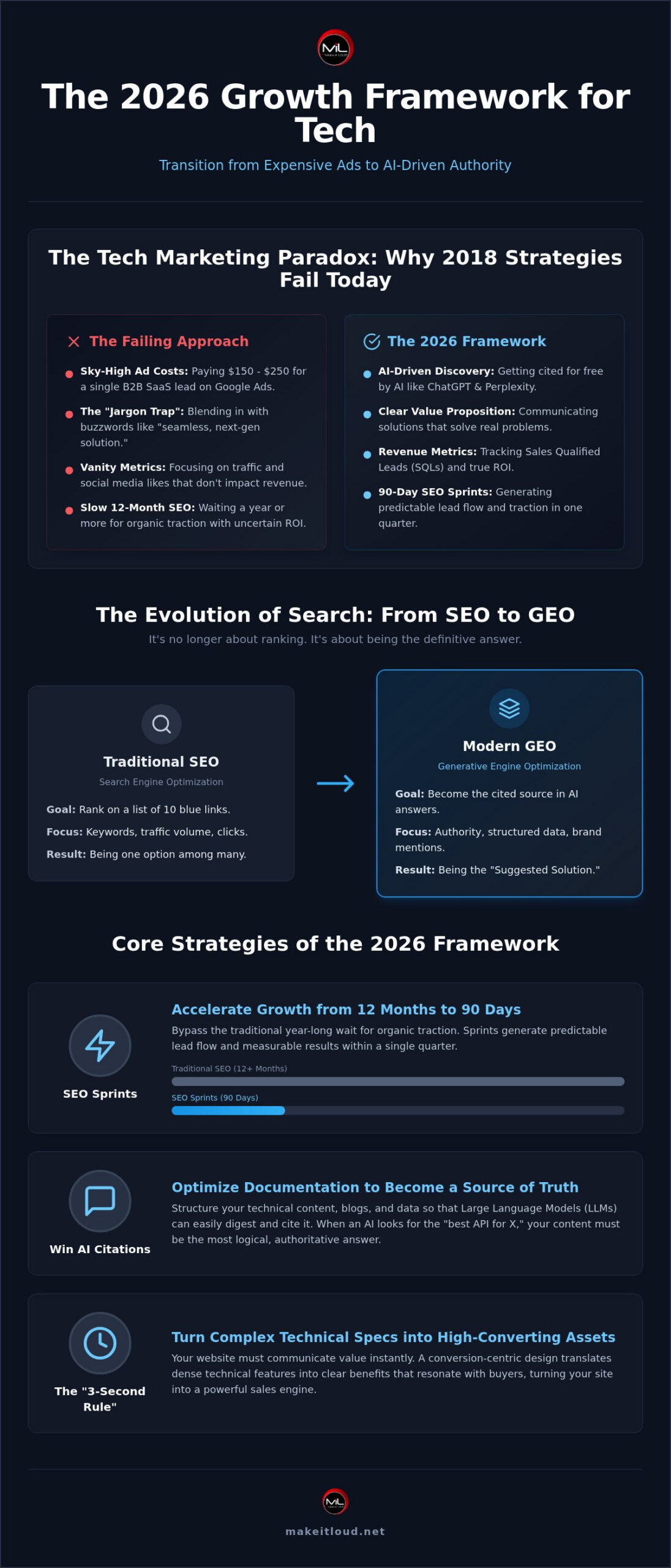
Tech founders are brilliant at building products but often find themselves trapped in a marketing paradox. You innovate at light speed, yet your growth strategies often feel stuck in 2018. The biggest culprit is the “Jargon Trap” often found in digital marketing for tech companies. When every SaaS brand claims to be a “seamless, next-gen solution,” they all blend into a sea of noise. This lack of differentiation kills conversion rates because it fails to communicate actual value to your prospects. They don’t want buzzwords; they want a solution that works.
Many leaders view digital marketing as a necessary evil or a black box. You pour money in, and maybe rankings go up, but does the bank account grow? Traditional SEO often prioritizes volume-based traffic, which looks great on a graph but does nothing for your bottom line. In 2026, the game has shifted toward intent-based discovery. It isn’t about how many people see you; it’s about being seen by the person ready to sign a contract. Stop treating marketing as a line-item expense. It’s a customer acquisition engine designed to produce a measurable return on investment.
Breaking the Cycle of Marketing Skepticism
Technical stakeholders are naturally skeptical of flashy promises. You deal in data, logic, and results. Why should your marketing be any different? We believe transparency is the only way to build trust. This means moving away from vanity metrics like social media “likes” or “impressions.” Those don’t pay the bills. Instead, we focus on revenue metrics: Sales Qualified Leads (SQLs) and actual ROI. A straight-talk partner doesn’t hide behind complex reports. They tell you exactly what’s working, what isn’t, and how we’re fixing it. This honesty is the foundation of effective digital marketing for tech companies.
The Cost of Inaction in a Fast-Moving Sector
The tech world moves fast, and laggards are quickly replaced by agile startups. If you’re still relying on a 2024 marketing plan, you’re already behind. The landscape has changed. Relying solely on paid ads is becoming a dangerous game. With B2B SaaS qualified leads on Google Ads now costing between $150 and $250, a bidding war can drain your budget before you see a single conversion. Modern SEO and Generative Engine Optimization (GEO) are no longer optional extras. They are the primary ways to defend your market share. Waiting to adapt isn’t just a delay; it’s a risk to your company’s financial health.
From SEO to GEO: Dominating the AI-Driven Search Landscape
The search landscape has fractured. While traditional SEO still matters, tech buyers are increasingly turning to AI answer engines like Perplexity, ChatGPT, and Gemini to solve complex problems. For these users, a list of ten blue links is often a hurdle rather than a help. They want a synthesized answer that cuts through the noise. This shift is why Generative Engine Optimization (GEO) has become the core of modern digital marketing for tech companies. GEO is the process of optimizing for AI-driven citations and brand mentions. It’s no longer enough to rank for a specific keyword. You must become the “Suggested Solution” that the AI trusts enough to cite.
Winning the AI Citation Game
AI models don’t guess; they parse. To win this game, you must structure your technical documentation and blog content so Large Language Models (LLMs) can easily digest it. This involves using clear schema, concise headers, and authoritative data points. When an AI looks for the “best API for fintech integration,” it searches for a source of truth. If your content provides the most logical, well-supported answer, the AI cites you as the primary source. This makes the AEO vs SEO debate the most critical conversation for tech CMOs today. One focuses on clicks; the other focuses on being the definitive answer. If you aren’t sure where your site stands, our team can help you audit your AI readiness today.
Brand Sentiment and Generative Results
AI models reflect the data they were trained on. If the web is full of outdated specs or unresolved complaints about your software, the AI will mirror that sentiment in its answers. You need to actively monitor how generative models describe your brand compared to your competitors. Improving your “brand footprint” involves more than just publishing content. It requires a strategic push to ensure positive, accurate information is indexed across high-authority platforms. We even use tools like AI customer service to feed structured, helpful data back into the digital ecosystem. This ensures that when an AI evaluates your brand, it sees a reliable, modern leader rather than a legacy relic. Digital marketing for tech companies in 2026 is about managing this digital reputation at scale.
SEO Sprints: Accelerating Growth for SaaS and IT Services
Traditional agencies often tell you that organic growth takes twelve months. In the software world, twelve months is an eternity. You could launch, scale, or go obsolete in that timeframe. This is why we’ve pioneered a high-intensity approach to digital marketing for tech companies. By utilizing SEO Sprints, we move away from the slow-burn model and focus on aggressive, 90-day execution phases. This isn’t about waiting for the “Google gods” to notice you; it’s about forcing the issue through technical precision and rapid content deployment. We focus on high-intent, “bottom of funnel” technical queries first, ensuring that the traffic you get is actually ready to buy.
The 30-60-90 Day Tech Growth Roadmap
Our roadmap is built for speed and measurable progress. During the first 30 days, we identify “low-hanging fruit” in your technical site structure. We fix crawl errors, improve site speed, and ensure your documentation is indexable. From days 31 to 60, we execute content sprints targeting niche technical pain points your competitors are ignoring. Finally, from days 61 to 90, we focus on conversion rate optimization (CRO). We turn that new traffic into product trials or demo requests by refining your calls to action and landing page layouts. This methodical flow ensures you aren’t just getting visitors; you’re getting users.
Data-Driven Ad Management for Tech
While the sprint builds organic momentum, we use Google Adwords Management to buy immediate data. Why guess which keywords convert when you can know the answer in 48 hours? Generic ads fail in the tech sector because they treat all users the same. Your campaign must speak to both the Technical Buyer looking for integration specs and the Economic Buyer looking for a bottom-line impact. We target these groups with distinct messaging and then use social media advertising to retarget them. This multi-touch approach keeps your solution top-of-mind during long B2B sales cycles. By combining paid data with organic sprints, your digital marketing for tech companies becomes a closed-loop system for growth.
Conversion-Centric Web Design: Turning Specs into Sales
Most tech websites suffer from a common flaw: they are built by engineers, for engineers. They are feature-heavy but benefit-poor. While your team might be proud of a specific API integration or a unique codebase, your buyer wants to know if it reduces churn or saves them money. If a visitor can’t grasp that value within the first three seconds, they will leave. This “3-Second Rule” is non-negotiable for high-stakes digital marketing for tech companies. Your site must also be ready for the AI-driven web. This means implementing robust schema and a mobile-first architecture that functions as a clean data source for search engines. To maximize lead capture, we integrate AI-powered customer service tools that qualify prospects 24/7, ensuring no lead falls through the cracks while your sales team sleeps.
The UX of Technical Decision Making
Technical buyers value their time above all else. If your pricing is hidden or your navigation is a maze, they won’t stick around. Transparency is the ultimate trust builder. We apply modern web design principles to simplify complex B2B interfaces. This includes making technical case studies and social proof easily accessible. Don’t hide your documentation; use it as a conversion tool. When a CTO sees that you’ve solved a problem similar to theirs, the sales cycle shortens significantly. We focus on creating a path of least resistance from the initial click to the final demo request.
Speed and Performance as a Ranking Factor
A slow website is the fastest way to lose a technical audience. If your site takes five seconds to load, a developer will assume your software is just as bloated. We look beyond basic metrics to optimize your Core Web Vitals for real-world performance. This isn’t just about pleasing users; it’s about pleasing the algorithms. Generative engines prioritize fast, structured sites when looking for answers to cite. By maintaining a high-performance site, you ensure your brand remains a primary source in the AI ecosystem. If your current site is holding you back, it’s time for a change. You can view our web design services to see how we turn technical specs into high-performing sales assets.
Partnering for Success: Why Atlanta’s Tech Scene Needs Straight Talk
Atlanta’s tech corridor is diverse. It stretches from the fintech hubs in Midtown to the enterprise IT giants in Alpharetta. Navigating this unique landscape requires more than just a generic playbook. It requires a partner who understands the Georgia business environment from the ground up. Why settle for a national agency that can’t find Sandy Springs on a map? A local firm offers the cultural context and networking power that remote teams simply lack. This proximity is a competitive advantage for digital marketing for tech companies, where local reputation often drives high-value B2B introductions.
For new tech ventures, the stakes are even higher. You aren’t just building a product; you’re building a brand in an increasingly crowded market. This is where startup consulting becomes vital. It provides the straight talk needed to avoid over-spending on unproven channels during your critical launch phase. You need a partner who prioritizes your financial health over their own award shelf. If an agency is more focused on their design trophies than your cost-per-acquisition, they aren’t the right fit for a growth-minded founder.
The Value of an Authoritative Veteran
Experience matters in a sector that changes every week. We’ve been helping businesses grow since 2004. This longevity lets us filter out “marketing fads” from real, revenue-driving trends. Our straight-shooter approach to digital marketing for tech companies means we don’t hide behind complex jargon or vanity metrics. We tell you exactly what’s working and what needs to change. Personal service beats the big box agency model every time. You deserve a dedicated team of experts, not a rotating door of junior account managers who don’t understand your codebase.
Next Steps: Scaling Your Tech Brand in 2026
Ready to scale? Start with a comprehensive Marketing Health Check. Audit your current SaaS or IT firm’s performance to see where your budget is leaking. Are your leads actually closing, or are you just buying clicks? Set realistic KPIs for the next two quarters and focus on sustainable, intent-based growth. Don’t let your 2024 plan dictate your 2026 results. When you’re ready for a partner that speaks your language and values your ROI, Schedule a Strategy Session with Make It Loud. Let’s build a framework that puts your brand at the center of the AI-driven search era.
Future-Proof Your Tech Growth Strategy
The 2026 landscape doesn’t reward those who wait for traditional methods to catch up. To dominate, you must shift your focus from chasing high-volume keywords to securing AI citations through Generative Engine Optimization. Speed is your greatest asset. By utilizing high-intensity SEO Sprints and conversion-centric web design, you can bypass the traditional twelve-month wait for results. You’ve built a technical product that solves real problems; your marketing should reflect that same level of innovation and precision.
This framework isn’t just a theory; it’s the new standard for digital marketing for tech companies that value transparency and measurable ROI. As a locally owned Atlanta agency with over 20 years in digital marketing, we’ve seen every industry shift since 2004. We specialize in GEO and AI integration to ensure your brand remains a primary source of truth in an automated world. We don’t hide behind jargon or vanity metrics. We deliver the tangible outcomes your board expects.
Ready for straight talk and real results? Let’s build your tech growth engine.
Your innovation deserves a strategy that moves as fast as you do. Let’s get started on your next phase of growth today.
Frequently Asked Questions
How is marketing for tech companies different from traditional B2B marketing?
Tech marketing focuses on translating complex technical specifications into tangible business outcomes for diverse stakeholders. Traditional B2B often relies on broad relationship building. In the tech sector, you must satisfy the Technical Buyer’s need for data while showing the Economic Buyer a clear ROI. Effective digital marketing for tech companies requires a deep understanding of these non-linear, research-heavy buying cycles.
What is the ROI of GEO (Generative Engine Optimization) for SaaS?
The ROI of GEO is measured by your brand’s presence in AI-generated answers and the resulting trial sign-ups. By becoming a cited source in tools like ChatGPT, you capture high-intent users without the high cost of paid bidding. It turns your documentation into a lead-generation asset. This reduces your long-term dependency on expensive advertising while building permanent authority in your niche.
Do we really need SEO if we are already running Google Ads?
Google Ads provide immediate traffic and valuable keyword data, but they stop working the moment you stop paying. SEO builds a sustainable asset that produces leads over time. Since B2B SaaS leads can cost over $150 on ad platforms, a balanced strategy is essential. SEO eventually lowers your overall acquisition costs by providing a steady stream of organic conversions.
How long does it take to see results from an SEO Sprint?
Our SEO Sprints are designed to produce measurable results within 90 days. We move away from the slow-burn model used by most agencies. By front-loading technical audits and high-intent content creation, we see movement in search visibility and lead flow much faster. It’s an aggressive approach for companies that can’t afford to wait a year for growth.
Why is web design more critical for tech companies than other sectors?
Technical decision-makers view your website as a reflection of your product’s engineering quality. A slow or cluttered site suggests a bloated or unreliable software solution. Tech web design must prioritize speed, clean architecture, and benefit-driven messaging. If you don’t communicate your value within three seconds, a technical audience will bounce to a competitor with a better user experience.
How can AI customer service improve our marketing conversion rates?
AI customer service improves conversions by providing instant technical support at the exact moment a prospect is researching. Most buyers won’t wait for an email reply the next business day. By answering queries 24/7, you qualify leads and move them toward a demo or trial immediately. This prevents lead leakage and ensures your marketing efforts aren’t wasted on unanswered questions.
What are the most important KPIs for a tech company’s digital marketing?
The most critical KPIs are Sales Qualified Leads (SQLs), demo conversion rates, and Customer Acquisition Cost (CAC). While traffic and rankings provide context, they don’t pay the bills. Technical founders should focus on how digital marketing for tech companies impacts the bottom line. Track your “lead-to-opportunity” ratio to ensure your traffic is high-intent rather than just high-volume.
Can a local Atlanta agency handle a national or global tech brand?
Absolutely. Being a locally owned Atlanta agency allows us to offer a level of transparency and personal service that “big box” firms can’t match. We combine this personal touch with 20 years of experience managing national and global brands. You get the high-level expertise required for global scaling without the bureaucracy and impersonal feel of a massive corporation.