

By 2026, ranking on the first page of Google is no longer the ultimate victory. It’s just the entry fee. You’ve probably noticed that even when your site sits at the top, your clicks are disappearing into AI-generated summaries. It’s a common frustration for business owners who’ve invested heavily in traditional digital marketing. As the landscape shifts, the central question has become: what is geo vs seo, and which one actually deserves your budget? Understanding the difference is the only way to protect your traffic from being swallowed by AI overviews.
We’ve spent over 20 years watching search engines evolve, and this shift is the most significant one yet. This guide provides an honest look at how Generative Engine Optimization works alongside traditional SEO to keep your brand relevant. You’ll learn how to feed the AI librarian the right data while maintaining the technical foundation that Google still requires. We’re moving past the jargon to give you a clear, actionable strategy for 2026. It’s time to secure your visibility and ensure your marketing ROI remains strong in the age of AI search.
Key Takeaways
- Understand the core distinction of what is geo vs seo to ensure your business remains the primary source for AI-driven answers rather than just a link in a list.
- Learn how to adapt your content for Large Language Models that prioritize context, relationships, and user intent over traditional keyword matching.
- Prepare for the zero-click reality by shifting your marketing focus from simple traffic volume to high-value brand impressions within AI overviews.
- Implement a dual-optimization strategy that maintains technical SEO health while building the deep authority required for AI recommendations.
- Discover how agile strategies like SEO Sprints provide the speed necessary to stay visible as search algorithms continue to evolve through 2026.
What is GEO vs SEO? The 2026 Reality Check
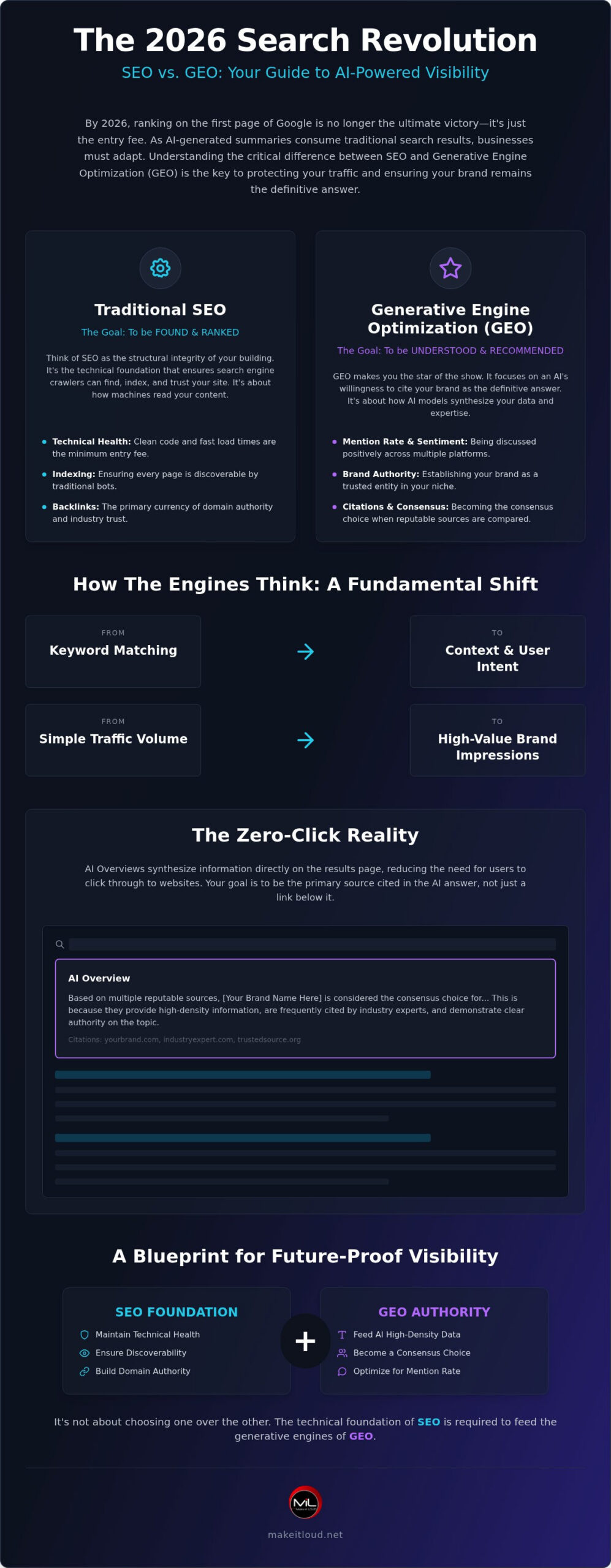
2026 has arrived, and the digital landscape is officially unrecognizable to those clinging to 2020 tactics. For over twenty years, we’ve helped businesses climb the “blue link” ladder. But the tipping point is here. Generative search now dominates the user experience. If you aren’t being cited by AI, you’re effectively invisible to a huge portion of your market. Understanding what is geo vs seo requires a fundamental mindset shift. Traditional SEO focuses on a machine’s ability to find and rank your website. GEO focuses on an AI’s willingness to recommend your brand as the definitive answer. It’s a move from simple keyword matching to establishing deep brand authority and consistent citations.
The Core Definition of SEO in 2026
SEO remains your digital foundation. Think of it as the structural integrity of your building. If Google’s crawlers can’t index your site or if your technical health is poor, no AI engine will ever trust your data. SEO ensures you’re in the library, even if the way people find books has changed. It’s about the “how” of search: how bots read your site and how they determine your baseline trust level. High-quality backlinks still serve as the primary currency of the web, signaling to search engines that your content is worth a reference. Without this foundation, your modern marketing efforts will crumble.
- Technical Health: Clean code and fast load times are now the minimum entry fee.
- Indexing: Ensuring every page is discoverable by traditional bots.
- Backlinks: These remain the most reliable signal of domain authority and industry trust.
The Rise of Generative Engine Optimization (GEO)
While SEO gets you into the building, GEO makes you the star of the show. AI models like ChatGPT, Claude, and Gemini don’t just display links; they synthesize information from across the web to create a single, cohesive response. To win in this environment, you must optimize for “mention rate” and “sentiment.” It’s no longer enough to just rank for a term. You need your brand to be discussed in a positive, authoritative context across multiple platforms. AI looks for patterns of trust. When multiple reputable sources cite your expertise, the AI views your business as the consensus choice. The debate over what is geo vs seo isn’t about choosing one over the other. It’s about evolution. You need the technical foundation of SEO to feed the generative engines of GEO. In 2026, citations are the new keywords.
How the Engines Think: Crawlers vs. Large Language Models
Traditional search engines function like a sophisticated filing cabinet. When you ask a question, the algorithm looks through its indexed folders to find the best match based on keywords and technical signals. But as we explore what is geo vs seo, we see that AI engines operate differently. They don’t just look for matches; they synthesize intent. While a human reads a website to gain knowledge or entertainment, an AI reads by mathematically mapping the statistical connections between your brand’s claims and established facts across the digital web.
The Mechanics of Traditional Search
Traditional SEO relies on crawlers to map out the structure of your site. In the past, keyword density and metadata were the primary levers you could pull to move the needle. While these factors still matter, they’ve become the baseline. Google now uses “Helpful Content” signals to determine if a page actually solves a user’s problem. Site speed and mobile-first indexing are non-negotiable technical requirements. If your site doesn’t load in under three seconds, the filing cabinet stays closed. It’s a deterministic system: you provide the right signals, and the machine rewards you with a rank.
Inside the AI ‘Brain’
AI Transformers and Large Language Models (LLMs) don’t rank pages in the traditional sense. Instead, they use Vector Search to understand the semantic relevance between concepts. They look at the “distance” between your brand and the topics you discuss. This is where the core of what is geo vs seo becomes clear. SEO is about being found, but GEO is about being understood and cited. If you’re looking to bridge this gap, our team at Make It Loud specializes in aligning your technical SEO with modern GEO requirements.
The “Citation Game” is how AI decides which brands to mention in its generated summaries. It looks for consensus across the web. If your site is filled with “fluff”-content that uses 1,000 words to say something that only needs 100-you’ll likely be ignored. AI engines prioritize high information density. They want the facts, the data, and the unique insights that verify your authority. Old-school SEO might have let you hide behind long-form filler, but the AI brain sees right through it. To win, you must provide the clear, verifiable data points that these models crave.
In 2026, the engines aren’t just looking for keywords. They’re looking for relationships. They want to know who you are, what you know, and who else trusts you. This shift means your content must be leaner, more factual, and deeply connected to your core business expertise. You need to stop writing for the bot and start writing for the citation.
The Zero-Click Challenge: Why Traditional SEO Isn’t Enough
The game has changed. You might hold the top spot for a competitive keyword, yet your analytics show a steady decline in traffic. Why? Because searchers no longer need to click. They get their answer directly from the AI overview at the top of the page. This is the zero-click reality. It’s a bitter pill for business owners who’ve spent years chasing traffic volume. But here’s the honest truth: appearing as the cited source in an AI summary is often more valuable than ranking fourth in the old blue links. It positions you as the authority the machine trusts. When users see your brand name attached to a definitive answer, you’ve won the impression, even if you didn’t get the session.
Some skeptics ask if you can actually track ROI in a GEO world. The answer is yes, but the tools are different. We look at brand search lift, call volume, and lead quality. When an AI recommends you, the customers who do reach out are usually ready to sign. They’ve already been “pre-sold” by the machine’s recommendation. You aren’t just a link anymore; you’re the expert the AI chose to highlight.
SEO vs GEO: A Direct Comparison
To master the 2026 landscape, you have to distinguish between different goals. Traditional SEO focuses on clicks and sessions. The metric is “how many people landed on my page.” GEO focuses on brand mentions and sentiment. The metric is “how often did the AI use me as a source.” When discussing what is geo vs seo, remember that SEO is a slow, structural build. It’s your foundation. GEO requires constant authority maintenance. It’s your reputation. SEO aims for rankings; GEO aims for inclusion in the AI’s synthesized response.
Surviving the Zero-Click Era in Atlanta
For local businesses, the shift is even more dramatic. When an Atlanta resident asks their phone for a nearby service, the AI isn’t browsing a list. It’s giving a single, confident recommendation. Your Google Business Profile is the secret weapon here. It’s no longer just a map listing; it’s a primary data source for the AI brain. We optimize these profiles to ensure the data is lean, factual, and authoritative. If your business isn’t the answer provided by the AI, you effectively don’t exist to that customer. It’s a harsh reality, but a manageable one if you have a partner who understands the new rules.
Dual Optimization: A Blueprint for Small Business Visibility
Success in 2026 requires a two-pronged approach. You can’t ignore the technical foundation of your website, but you also can’t ignore how AI models perceive your brand. Many business owners get lost in the jargon of what is geo vs seo, yet the solution is surprisingly straightforward. It starts with a clean technical audit. If search bots encounter broken links or slow load times, they won’t pass your data to the generative engines. Once your house is in order, you must focus on E-E-A-T. AI models prioritize content that demonstrates real-world experience and deep expertise. They want to see that you aren’t just another generic voice in a crowded digital room.
The next phase involves shifting your content strategy toward conversational answers. Users ask AI “why” and “how” more than ever. Your website should provide direct, plain-English solutions to these queries. Finally, you need a robust citation management plan. This means ensuring your brand is mentioned across reputable third-party sites, press releases, and industry directories. These digital footprints prove to the AI that you are a legitimate, trusted entity in your field.
Optimizing for AI Citations
AI engines love structured data. By implementing Schema markup, you provide a clear map that helps LLMs ingest your facts without confusion. We focus on creating “quotable” facts. These are concise, data-driven statements that are easy for an AI to extract and credit to your brand. Don’t underestimate the power of third-party reviews and press mentions. When other authoritative sites talk about you, the AI considers it a vote of confidence. This consensus is what lands you in the coveted AI summary box.
The Power of Local GEO
For businesses serving a specific area, your Google Business Profile is your most valuable asset. It’s the primary data source for “near me” queries. In 2026, AI uses this profile to verify your physical presence and service quality. Local citations must be consistent. Your Name, Address, and Phone number (NAP) need to be identical across every platform. Any discrepancy creates “friction” for the AI, which can lead it to recommend a competitor instead. If you want to dominate your local market, contact Make It Loud for a comprehensive search audit today.
Future-Proofing Your Business with Make It Loud
Traditional agencies often move at a glacial pace. They spend months on discovery and planning while the digital landscape shifts in weeks. In the AI era, this slowness is a liability. You need a partner who understands what is geo vs seo and can pivot your strategy in real-time. Since 2004, we’ve navigated every major algorithm shift with a focus on one thing: your bottom line. We don’t offer empty promises or flashy reports. We offer a direct path to visibility through honest, results-driven work.
Our approach is built for the 2026 market. We combine the technical depth of traditional search with the synthesis-focused tactics of AEO and SEO. This ensures your brand is both findable by bots and recommendable by AI. To achieve this quickly, we pioneered SEO Sprints. These are high-impact, agile work blocks designed to deliver measurable progress without the long-term bloat of traditional contracts. We focus on speed, efficiency, and measurable ROI.
Why Atlanta Businesses Trust Our Straight-Talk Approach
We’ve spent over 20 years evolving alongside the search engines. This longevity isn’t just a number; it’s a testament to our reliability as a stable partner in an uncertain industry. We’ve seen trends come and go, but our commitment to transparency remains. We treat your financial health as our own. You won’t hear us hiding behind technical jargon. Instead, we provide clear, assertive guidance to keep you ahead of AI trends so you can focus on running your business. We are locally rooted but nationally capable, offering a personal touch that automated agencies simply can’t match.
Ready to Start Your 2026 SEO Sprint?
Your journey starts with a rapid audit of your current digital standing. We’ll identify exactly where you’re losing ground to AI overviews and traditional competitors. Within the first 30 days, we implement a modern optimization strategy focused on high-value brand impressions and technical site health. We move fast because your business can’t afford to wait. Don’t let your business get left behind in the “blue link” past. Contact us today for a results-driven consultation and secure your place in the future of search.
Secure Your Search Presence for 2026
The shift from traditional search lists to AI-generated answers is no longer a prediction; it is your current reality. By now, you should have a clear grasp of what is geo vs seo and how they work together to protect your digital footprint. SEO provides the technical structure that keeps you visible to bots. GEO builds the brand authority required to win citations from AI models. You don’t have to choose between them. You simply have to evolve.
At Make It Loud, we’ve spent over 20 years helping businesses navigate these exact types of industry pivots. As locally owned Atlanta experts, we pride ourselves on transparency and tangible outcomes. We don’t believe in long-term bloat. This is why we offer specialized SEO Sprints to deliver rapid ROI in a fast-moving market. It’s time to stop letting zero-click searches drain your leads. Stop guessing and start growing. Get your 2026 SEO & GEO audit from Make It Loud today. The AI era is full of opportunity for those who act now. We are ready to help you lead the way.
Frequently Asked Questions
What is the main difference between GEO and SEO?
SEO focuses on ranking your website in a list of results. GEO focuses on convincing AI models to cite your brand as the definitive answer. When asking what is geo vs seo, think of it as the difference between being a book in a library and being the expert the librarian quotes. SEO builds the structure, while GEO builds the reputation. Both are essential for modern visibility in the 2026 landscape.
Is traditional SEO dead in 2026?
Traditional SEO is not dead; it’s the necessary foundation for all digital visibility. AI engines still rely on crawled data to verify facts. If your technical SEO is broken, no generative engine will trust your content. Think of SEO as the structural integrity of your building. Without it, you cannot support the advanced reputation-building required for modern search. It remains the entry fee for any digital strategy.
How do I optimize my website for AI search engines like ChatGPT?
You optimize for AI by providing high information density and clear, structured data. Start by implementing Schema markup to help LLMs ingest your facts easily. Create “quotable” sentences that answer specific questions directly. AI models prefer factual, data-driven content over marketing fluff. Focus on being a primary source of information within your specific industry niche to ensure the AI selects your brand as its primary source.
What are zero-click searches and how do they affect my business?
Zero-click searches occur when a user gets their answer directly on the search results page without clicking a link. This reduces your website sessions but increases the value of brand impressions. If the AI cites you, you win the customer’s trust before they even visit your site. You must shift your mindset from pure traffic volume to becoming the trusted source the AI recommends to its users.
Can a small business compete with big brands in GEO results?
Small businesses can absolutely compete by dominating local authority and niche expertise. AI engines often prioritize specific, verified local data over generic national results. By focusing on your unique service area and gathering authentic reviews, you can become the consensus choice in your market. It’s about being the most relevant answer for a specific query, not having the biggest budget. Relevance often beats raw size in AI search.
Does my Google Business Profile help with GEO?
Your Google Business Profile is a critical data source for local AI search results. When someone asks an AI for a local service, the engine pulls data from your profile to verify your location and reputation. We optimize these profiles to ensure your information is lean and factual. A well-maintained profile acts as a secret weapon for winning local AI recommendations and appearing in synthesized local summaries.
How do I measure the success of a GEO strategy?
Success in GEO is measured through brand mentions, sentiment analysis, and brand search lift. You should track how often AI models cite your business as a source. Traditional metrics like call volume and lead quality remain vital. If an AI recommends you, the leads you receive are typically higher quality because the machine has already pre-sold your expertise to the user. Focus on brand authority over raw clicks.
Why is E-E-A-T more important for GEO than it was for SEO?
E-E-A-T is more critical for GEO because AI engines prioritize trust and verified expertise over simple keyword matching. These models look for patterns of authority across the web. If multiple reputable sources cite your experience, the AI views you as a safe recommendation. Understanding what is geo vs seo means recognizing that AI prioritizes who the digital world trusts as a legitimate, factual expert in their specific field.