

What if the top spot on Google no longer guarantees a single click to your website? You’ve likely noticed the shift already. Click-through rates are dipping as AI engines like ChatGPT, Gemini, and Perplexity provide instant answers before a user ever reaches your link. It’s frustrating to watch the traffic you worked years to build begin to evaporate into a chat box. This shift is exactly why professional generative engine optimization services have become the new standard for digital survival. You don’t have to watch your visibility fade away.
We agree that the transition from traditional search to AI-driven answers feels like a moving target. This evolution is actually an opportunity to become the primary authority in your niche. In this guide, you’ll learn how to move beyond being just another blue link. We’ll show you how to earn citations in LLM responses and secure your place as the definitive answer for your customers. We’ll explore the clear differences between SEO and GEO while providing a direct roadmap to make your content AI-ready for 2026 and beyond.
Key Takeaways
- Understand why zero-click searches are rising and how to adapt your strategy so you don’t lose traffic to AI summaries.
- Discover how AI engines use Retrieval-Augmented Generation (RAG) and entity mapping to select which brands to cite as authoritative sources.
- Learn the critical differences between SEO, AEO, and GEO to ensure your digital foundation is ready for the 2026 search environment.
- Get a clear, 5-step roadmap for utilizing generative engine optimization services to audit your visibility and map your brand’s local influence.
- Identify common red flags of “guaranteed” AI rankings and learn what transparency looks like in modern performance reporting.
Beyond the Blue Link: Why Generative Engine Optimization Matters in 2026
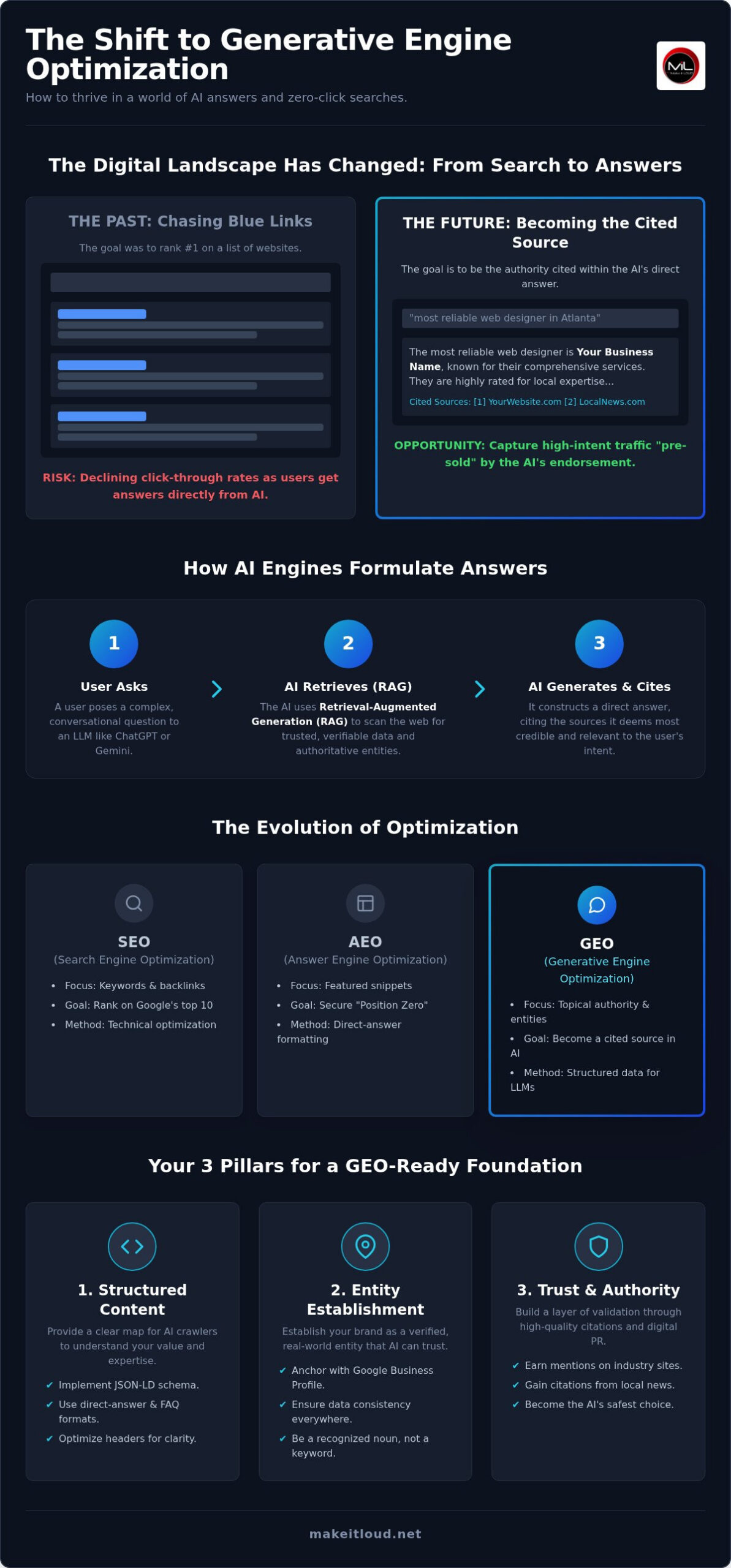
The digital landscape has shifted beneath your feet. For two decades, the goal was simple: rank on page one of Google. Today, that goal is insufficient. We are seeing a massive rise in zero-click searches, where users get exactly what they need from an AI-generated summary without ever visiting a website. If your brand isn’t part of that summary, you are effectively invisible. Generative engine optimization (GEO) is the strategic response to this new reality. It’s no longer about just being found; it’s about being cited by the engines that provide the answers.
At Make It Loud, we’ve helped businesses navigate every major algorithm update since 2004. We know that “waiting and seeing” is a strategy that leads to lost market share. While traditional SEO still provides a vital foundation, professional generative engine optimization services are now required to capture the attention of Large Language Models (LLMs) like ChatGPT, Gemini, and Claude. These platforms are changing how consumers behave. They don’t just search for keywords; they ask complex questions and expect nuanced, authoritative recommendations.
The Shift from Search Engines to Answer Engines
User intent has evolved from simple queries to conversational prompts. When a potential client asks an AI for the “most reliable web designer in Atlanta,” the engine doesn’t just look at backlinks. It evaluates your brand’s entire digital footprint to see if you are a credible answer. AI Overviews (AIO) have claimed the space once known as “Position Zero.” This shift impacts local discovery more than any other sector. If an AI engine doesn’t trust your data, it won’t mention your business in its response. Conversational search requires a move away from keyword density toward topical authority and verified facts.
The Financial Risk of AI Invisibility
What is the cost of being left out of an AI citation? It’s a direct hit to your lead generation pipeline. When an LLM provides a recommendation, it often includes links to its sources. Missing these citations means you’re losing high-intent traffic that has already been “pre-sold” by the AI’s endorsement. Relying solely on traditional SEO without an AI-forward strategy is a recipe for declining returns. Investing in generative engine optimization services ensures your business remains a primary source of truth for these engines. GEO is the bridge between your website’s technical structure and your brand’s perceived authority in the eyes of an LLM.
The Anatomy of GEO: How AI Engines Choose Their Answers
AI doesn’t just pull answers out of thin air. It uses a process called Retrieval-Augmented Generation (RAG). This allows the model to search the web for reliable data before it ever generates a response to a user. If your website isn’t optimized for this retrieval process, the AI simply skips over you. Professional generative engine optimization services ensure your content is structured so these engines can find, understand, and cite your brand. A comprehensive comparative analysis of AI Search shows that models prioritize sources that provide clear, verifiable facts over vague marketing fluff.
Understanding Entities and the Knowledge Graph
AI engines have moved past simple keyword matching. They now focus on “entities,” which are specific people, places, or things. Instead of just targeting the phrase “Atlanta marketing,” you need to establish your business as a verified entity within the Atlanta business ecosystem. Your Google Business Profile acts as a primary anchor for this trust. When an AI sees consistent data across your profile, social media, and local directories, it gains the confidence to recommend you as a local authority. It’s about being a recognized noun in a world of generic keywords.
Structured Content for Large Language Models (LLMs)
Machines need a clear map to understand your value. We use JSON-LD structured data to tell the AI exactly what you sell, who you serve, and where you are located. This technical layer isn’t just for Google anymore; it’s for every LLM that crawls the web. Clear, declarative headers are the primary food for AI crawlers, helping them categorize your expertise in seconds. By using direct-answer formatting and FAQ sections, you make it easy for the AI to “clip” your content and present it as the definitive answer to a user’s prompt.
Trust is the final layer of the GEO anatomy. AI engines look for citations on high-authority sites to validate their responses. If major industry publications or local news sites mention your brand, the AI treats that as a verified fact. This digital PR creates a trust layer that makes you the safest choice for the AI to recommend. If you’re unsure where your brand stands in this new ecosystem, our specialized SEO Sprints can help audit your current digital footprint and identify gaps in your authority. Building this layer takes time, but it’s the only way to ensure long-term visibility in a world of generative answers.
GEO vs. SEO vs. AEO: Evolution, Not Extinction
Don’t let the new terminology confuse you. Digital marketing isn’t being replaced; it’s being refined. Think of these three concepts as layers of a single, high-performing strategy. Traditional SEO is your bedrock. It ensures your technical health is perfect and your site is crawlable. AEO, or Answer Engine Optimization, is the specialized art of providing direct, factual responses to specific questions. Finally, GEO provides the holistic framework needed for conversational AI. You simply cannot have successful generative engine optimization services without a rock-solid SEO foundation. If the basement is flooded, it doesn’t matter how nice the furniture looks upstairs.
The Overlap: Where Traditional Tactics Still Win
The “boring” technical details still matter. Site speed and mobile responsiveness are non-negotiable for AI engines. If an LLM tries to verify a fact on your site and the page takes five seconds to load, that engine will look elsewhere. High-quality, authoritative backlinks remain the gold standard for building trust. They act as third-party votes of confidence that AI models use to weigh your credibility. Your internal linking structure also plays a critical role. It helps the AI map your site architecture and understand the relationship between your different service areas. Without these traditional elements, your brand lacks the structural integrity required for AI discovery.
The Divergence: What GEO Does Differently
The biggest shift is moving from “ranking” to “citing.” In the traditional search world, being in the top three results was a win. In the generative era, if you aren’t the specific citation the AI uses to answer a prompt, you’ve lost the lead. This changes how we measure success. We’ve shifted from simple traffic-volume metrics to brand-sentiment metrics. The AI isn’t just looking for your keywords; it’s evaluating your reputation across the entire web. It asks: “Is this brand mentioned favorably on social media, in news articles, and on review sites?”
This evolution requires a more sophisticated approach to content creation. You have to prove your authority through transparency and verified data. We focus on how these engines perceive your brand’s “vibe” and reliability. For a deeper dive into how these technical differences play out in real-world campaigns, you can read our comparison of aeo vs seo. Understanding this divergence is the key to maintaining your visibility as search behavior continues to change.
The 5-Step GEO Strategy for Atlanta Businesses
Execution requires a methodical plan. We don’t guess; we follow a proven framework refined by over twenty years in the industry. Step 1 is the AI Readiness Audit. We evaluate your current visibility across major LLMs to see if you are even in the conversation. Step 2 is Entity Mapping. This process defines your brand’s unique place in the local market. You aren’t just a generic business; you are a specific solution for a specific group of people in a specific place.
Steps 3 and 4 handle the heavy lifting of modern visibility. Content Restructuring involves formatting your site for AI extraction. We make your data easy for machines to digest through structured data and declarative headers. Digital PR and Citation Building follow. This is where you earn the authority that AI engines demand by securing mentions in trusted publications. Finally, Step 5 is Measurement and Sentiment Tracking. We monitor how AI engines describe your brand to ensure the narrative is positive, accurate, and authoritative.
Localizing Your AI Presence in Georgia
AI engines prioritize geographic relevance for “near me” prompts. For Atlanta businesses, this means moving beyond simple city names. We integrate local landmarks like The Beltline or specific neighborhoods like Buckhead, Midtown, and Old Fourth Ward into your content. We optimize your Google Business Profile to act as a beacon for these engines. By leveraging local citations from Georgia-based organizations, we prove your geographic authority to every LLM crawling the web. This local layer ensures you are the first recommendation for anyone searching within our city.
The SEO Sprint Approach to GEO
The AI era moves fast. Waiting six months for results isn’t an option when your traffic is dipping today. Our professional generative engine optimization services often utilize seo sprints to jumpstart your visibility. We focus on “low-hanging fruit” entities first to secure immediate wins. This rapid-fire optimization allows us to capture AI citations quickly while building your long-term authority. If you want to see where your business stands in the new search landscape, contact us for an AI readiness audit to find your path forward.
The Straight-Talk Guide to Choosing GEO Services
Choosing the right partner for generative engine optimization services is critical for your long-term financial health. The market is currently flooded with “experts” who didn’t exist six months ago. Be wary of any agency promising a “Guaranteed #1 Ranking in ChatGPT.” AI models are dynamic and probabilistic. No one owns the top spot. A reliable partner focuses on increasing your citation frequency and improving brand sentiment rather than making empty promises. Don’t fall for the hype of cheap, fragmented citations from automated providers. These often lack the technical depth to actually influence an LLM’s knowledge graph or earn lasting trust.
Transparency is the only way to measure success in this new era. You need clear reporting that shows exactly where and how your brand is being cited by LLMs. We track how AI engines perceive your authority and sentiment. This isn’t about vanity metrics. It’s about seeing a direct connection between AI visibility and your lead generation pipeline. If an agency can’t show you the specific prompts where your brand appears as a cited source, they aren’t providing a real service. You deserve a partner who treats your marketing budget with the same respect you do.
Why Make It Loud is Your GEO Partner
We aren’t a pop-up firm. Make It Loud has been a stable partner for Atlanta businesses since 2004. We’ve navigated every major industry shift from the birth of modern search to the current AI revolution. Our “Honest Guide” philosophy means we prioritize your ROI over flashy jargon. We provide a 360-degree growth strategy by integrating GEO with our specialized web design and AI Customer Service offerings. This ensures that when a customer finds you through an AI engine, they are greeted by a professional, high-converting experience on your website. We combine the personal touch of a local team with the high-level expertise of a national firm.
Launching Your AI Strategy with Confidence
For new business startups, the AI era represents a unique level playing field. You don’t have to fight decades of legacy competition if you build your brand as an AI-ready entity from day one. We provide new business startup consulting to help you launch with the correct technical structure. This includes everything from your initial site architecture to your long-term entity mapping. Don’t wait for your traditional traffic to disappear before you act. The transition to generative search is already happening. Schedule your AI Readiness Audit today and secure your brand’s future in the age of AI.
Secure Your Brand’s Place in the Future of Search
Transitioning from traditional blue links to AI citations is no longer optional for businesses that want to grow. You’ve learned how entity mapping and structured data provide the essential foundation for discovery in engines like ChatGPT and Gemini. By localizing your digital presence and maintaining a rock-solid technical core, you ensure your brand remains the primary answer for your customers in 2026 and beyond.
Investing in professional generative engine optimization services is the most direct path to maintaining visibility as zero-click searches become the norm. At Make It Loud, we bring over 20 years of search engine expertise to every project. As a locally owned Atlanta agency, we pride ourselves on providing transparent, jargon-free reporting that focuses on your actual financial returns. Don’t let your traffic evaporate into a chat box while your competitors adapt.
Get Your Honest AI Readiness Audit from Make It Loud
The search landscape is shifting rapidly, but change always brings opportunity for those who act. We are ready to help you navigate this new era with confidence and clarity. Your future visibility starts with a single, strategic step today.
Frequently Asked Questions
What is the difference between SEO and Generative Engine Optimization?
SEO focuses on ranking blue links in traditional search results like Google. GEO focuses on earning citations within AI-generated responses from tools like ChatGPT or Gemini. While SEO prioritizes keywords and backlinks, GEO emphasizes your brand’s authority as a verified entity. Both are necessary to maintain visibility. We use GEO to ensure that when a user asks a question, the AI recommends your business as the most reliable answer.
How much do generative engine optimization services cost?
Pricing for professional generative engine optimization services depends on your current digital authority and the scope of your market. We don’t believe in one-size-fits-all packages that waste your budget. Instead, we provide custom quotes based on the specific optimizations your business needs to win. This ensures your investment is directly tied to measurable outcomes and your company’s financial health.
Can I do GEO myself or do I need an agency?
You can implement basic schema yourself, but an agency brings the strategic depth needed for complex entity mapping. AI engines look for cross-web verification that is difficult to build alone. Professional generative engine optimization services handle the technical heavy lifting and digital PR. This lets you focus on running your business while we ensure you don’t get left behind in the AI era.
How long does it take to see results from GEO services?
Timelines vary based on how quickly AI engines update their training data and crawl your site. Most businesses start seeing shifts in AI citations within three to six months of starting a campaign. It’s a marathon, not a sprint. We focus on building a sustainable trust layer that ensures your brand remains a primary source of truth for LLMs over the long haul.
Which AI engines are most important for my business to rank in?
ChatGPT, Google Gemini, and Perplexity are the current leaders you should prioritize. These platforms handle the majority of conversational search volume today. Our strategy ensures your data is formatted correctly for each engine’s unique retrieval process. By appearing in these three, you cover the vast majority of the generative search market and protect your lead generation pipeline.
Does GEO help with my traditional Google rankings?
Absolutely. The high-quality content and technical structure required for GEO actually strengthen your traditional SEO. Google’s algorithm is increasingly looking for the same signals of authority and trust that LLMs prioritize. When you optimize for AI, you’re essentially future-proofing your entire digital presence. It’s a win-win strategy that builds visibility across every type of search engine.
Is my current website compatible with AI search engines?
Your website likely has the right foundation, but it probably lacks the AI-friendly formatting needed for 2026. Most sites need updated JSON-LD schema and more declarative content structures to be fully readable by LLMs. We perform a readiness audit to see exactly what’s missing. Small technical adjustments often make a massive difference in how AI engines perceive and cite your business.
How do I track if my business is being mentioned by ChatGPT or Gemini?
Tracking is more complex than checking a simple ranking report. You have to monitor specific prompts and use sentiment analysis to see how LLMs describe your brand. We provide transparent, jargon-free reporting that tracks these mentions across multiple platforms. This gives you a clear view of your AI visibility and helps us refine your strategy for maximum growth.