
Did you know that traditional search engine volume has dropped by an estimated 25% as of 2026? If your click-through rates are plummeting, you aren’t alone. The digital landscape in Georgia has changed, and simply ranking on page one is no longer the gold standard for growth. To stay visible, your business must master generative engine optimization atlanta. Are you prepared for a world where AI agents do the searching for your customers?
It’s frustrating to watch your traffic dip while competitors appear as the top-cited answers in ChatGPT and Google AI Overviews. You might feel overwhelmed by technical jargon or fear that your brand is being left behind in this shift. We understand that concern. This guide promises to strip away the confusion and provide a clear roadmap for transitioning your traditional SEO into high-impact AI visibility. We will explore the core pillars of GEO, outline the exact steps to update your digital presence, and help you identify a stable Atlanta partner to manage this evolution for you.
Key Takeaways
- Understand the shift from traditional keyword ranking to becoming a cited authority in AI-generated answers.
- Discover how generative engine optimization atlanta ensures your business remains the top recommendation as traditional search volume declines.
- Identify the specific trust factors and brand sentiment signals that AI models use to evaluate your business’s reputation.
- Get a clear, four-step roadmap to audit your digital footprint and implement advanced Schema markup for all local services.
- Learn why partnering with a veteran agency that has navigated search shifts since 2004 is the safest way to protect your financial health.
What is Generative Engine Optimization (GEO)?
For over two decades, the goal of digital marketing was simple. You wanted to rank first on Google. In 2026, that goal has shifted. Users aren’t just scrolling through lists of blue links anymore. They’re asking complex questions and receiving instant, synthesized answers. This shift is exactly why generative engine optimization atlanta has become the most critical investment for local business owners who want to stay relevant. The era of the “Search Result” is giving way to the era of the “Cited Answer.”
So, what exactly is it? To understand What is Generative Engine Optimization, you have to look at how Large Language Models (LLMs) operate. GEO is the process of optimizing your digital presence so that AI engines like ChatGPT, Perplexity, and Google AI Overviews cite your business as a primary source. It’s no longer about tricking an algorithm with keyword density. It’s about becoming an undeniable authority that an AI feels confident recommending to a user. If your content isn’t citable, it’s invisible.
Why is 2026 the tipping point? Traditional search volume has dropped significantly as users migrate toward conversational interfaces. When a potential client in Midtown asks their AI for the “most reliable commercial roofer,” they don’t want a directory of twenty names. They want the single best answer. If you haven’t transitioned from traditional SEO to generative engine optimization atlanta, you’re missing out on the 17% of the market now dominated by ChatGPT and the millions of users relying on Google’s AI Overviews. Our 2026 Guide to Generative Engine Optimization breaks down exactly how these AI-driven search engines evaluate and recommend local businesses like yours.
The Rise of Answer Engines
Google Gemini and Bing Copilot have fundamentally altered user behavior. We’ve moved from “Search” to “Discovery.” In the past, a user would type a query and hunt for the right link. Now, they expect the engine to do the hunting for them. This is why traditional SEO is no longer enough to “Make It Loud” online. You need a strategy that feeds these engines the specific, structured data they need to validate your expertise. If you aren’t providing direct answers, you aren’t being found.
Why Atlanta Businesses Are at Risk
The rise of “Zero-Click” searches is a direct threat to local lead generation. If an AI provides your phone number, address, and service list directly in the chat interface, the user has no reason to click through to your website. AI models are highly selective. They filter out businesses that lack clear digital authority or have fragmented information across the web. GEO is the strategy of ensuring AI models recognize your brand as the definitive solution for a specific query. Without this clarity, your business becomes a ghost in the machine while competitors with better AI visibility capture the lead.
SEO vs. GEO: Understanding the 2026 Search Landscape
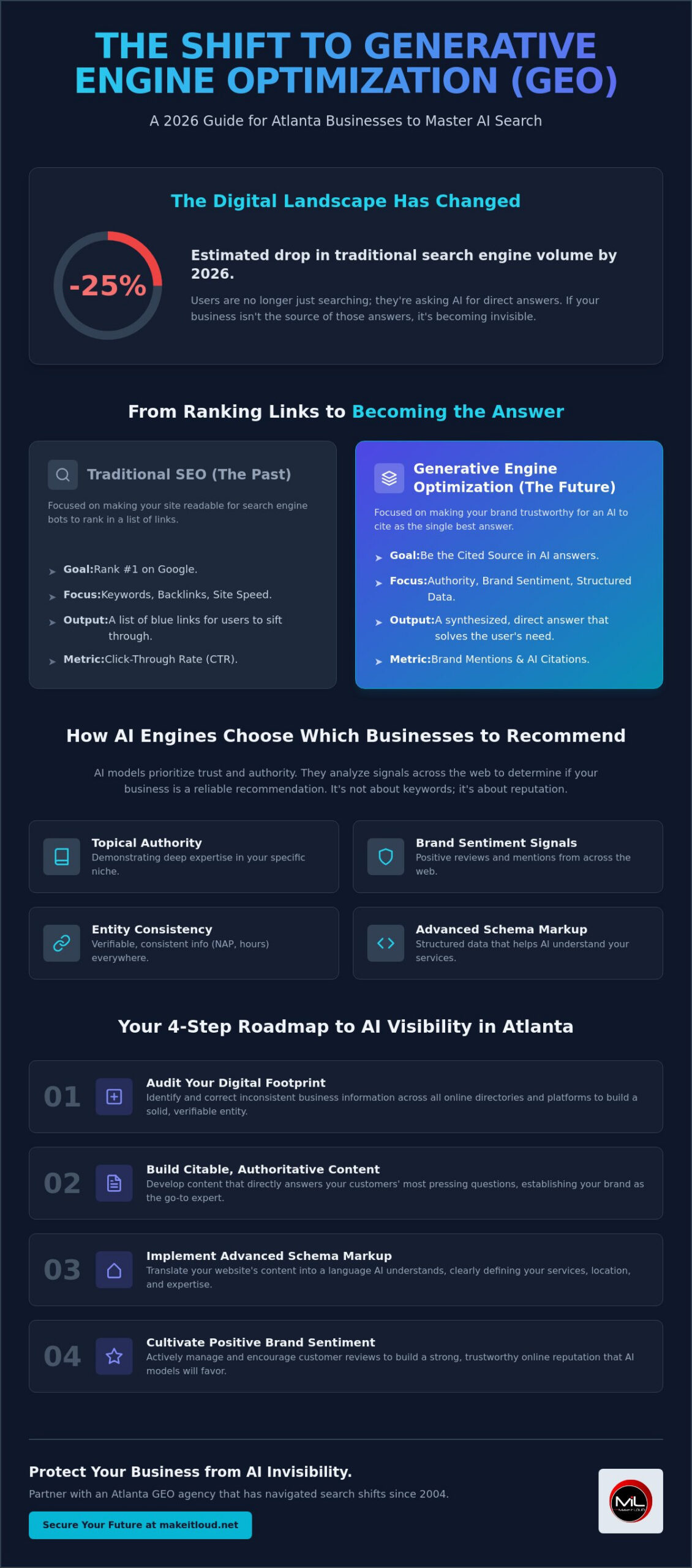
Rankings used to be the only metric that mattered. If you were in the top three results, you were winning. In 2026, that is no longer a guarantee of traffic. Traditional SEO is still the foundation of your digital house. You need a fast site, clean code, and logical structure to be indexed. However, generative engine optimization atlanta is the strategy that actually gets you invited into the conversation. While SEO focuses on making your site readable for a bot, GEO focuses on making your brand trustworthy for an intelligence.
The difference is visible in the output. A traditional search engine gives you a list of links. An AI engine gives you a synthesized answer. You might have a blog post ranking #1 on a traditional results page, yet find yourself completely excluded from an AI Overview. Why? Because AI models prioritize “Topical Authority” and brand sentiment over keyword density. They don’t just look for what you say about yourself; they look for what the rest of the web says about you. This is a shift from “ranking for keywords” to “becoming a cited authority.” To see how these concepts merge into a profitable plan, you can explore our ROI Driven SEO Strategy.
From Keywords to Entities
AI sees your business as an “Entity,” not just a URL. An entity is a real-world object with defined relationships. For a local business, your Google Business Profile is the digital birth certificate of your entity. It provides the location, service area, and customer sentiment data that AI engines crave. If your entity information is fragmented or inconsistent across the web, an AI engine will view you as a risk. It won’t recommend a business it can’t verify. A Practical Guide to GEO often emphasizes that cleaning up these entity signals is the first step toward visibility.
The Importance of Citations and Mentions
AI engines use “consensus” to determine which business to recommend. If multiple authoritative sources mention your Atlanta business as a leader in your field, the AI gains confidence. This has shifted the focus from the quantity of links to the quality of brand mentions. Being featured on a local Atlanta news site or a respected niche blog carries more weight than a hundred low-quality backlinks. AI models are trained to recognize expertise. They look for expert citations and peer reviews to validate your claims. If you want to stay ahead of the curve, it’s time to audit your digital presence for these authority signals. Quality mentions are the new currency of search.
How Generative Engines Choose Which Atlanta Businesses to Recommend
AI models don’t guess; they calculate. When a user asks for the best service provider in Midtown, the engine doesn’t just look for a keyword match. It performs a rapid-fire assessment of trust, relevance, and authority. This is the mechanical heart of generative engine optimization atlanta. If you want to be the business that the AI recommends, you have to understand the criteria it uses to judge you. It’s a shift from “tricking” a bot to “proving” your value to an intelligence.
The “Trust” factor is the most significant hurdle. AI models evaluate your reputation by looking for a consensus across the web. They compare your website data with third-party reviews, news mentions, and social signals. If your story is inconsistent, the AI views you as a hallucination risk and moves on to a competitor. Content relevance is the second pillar. AI engines prefer punchy, direct answers. If your website is buried in fluff, the AI won’t bother digging for the solution. It wants to provide the user with a specific answer immediately. Finally, technical clarity through Schema.org acts as a direct line to AI crawlers, telling them exactly who you are and what you do in a language they speak fluently.
The “Local Signal” is especially potent for businesses in our city. AI engines prioritize geographically relevant data. They look for mentions of Atlanta neighborhoods, local partnerships, and community involvement. By grounding your digital presence in the physical reality of Atlanta, you provide the AI with the context it needs to recommend you for local queries.
LLMs and the Knowledge Graph
AI models like GPT-4 and Google Gemini pull from the “Knowledge Graph,” a massive database of connected facts. To be included, your Atlanta headquarters and specific service areas must be explicitly defined in your metadata. Implementing AI Customer Service is a powerful way to feed accurate, real-time data back into this ecosystem. Every interaction helps the AI understand your business better, making it more likely to cite you as a trusted authority.
Addressing the Skepticism
Many business owners worry about AI “hallucinations” or their brand being misrepresented. GEO acts as a protective guardrail. By providing clear, structured data, you dictate the facts the AI uses, reducing the chance of error. Is this just for big brands? Absolutely not. In fact, local relevance is a major weight in AI decision-making. Small, locally-rooted businesses often have an advantage because their “entity” is easier for an AI to verify within a specific geographic context. This isn’t a temporary trend. It’s the next chapter in the long story of digital visibility, and we are here to help you lead it.
4 Steps to Optimize Your Business for AI Search in Atlanta
The shift to AI search isn’t a future theory; it’s a current reality. To stay visible, you need a methodical approach that prioritizes clarity over volume. First, audit your digital footprint for entity clarity. Does every platform say the same thing about your brand? Second, implement advanced Schema markup. This hidden code tells AI engines exactly what services you offer in Midtown or Decatur. Third, create “Answer-First” content. Solve specific Atlanta-based pain points immediately. Finally, build local authority through strategic citations. This four-step process is the core of generative engine optimization atlanta.
You can’t afford to be vague. AI models require definitive data to recommend you. If your website is still relying on 2018 tactics, you are essentially invisible to a generative engine. We focus on tangible outcomes, and that starts with making your data undeniable. By following these steps, you move from being a “maybe” to being the “only” solution the AI presents to a potential client.
Claiming Your Digital Territory in Atlanta
AI engines use geographic anchors to verify your location. Don’t just say you’re in Atlanta. Mention your proximity to the BeltLine, Buckhead, or Hartsfield-Jackson. These landmarks help the AI ground your business in a physical space. Ensure your Name, Address, and Phone (NAP) data is identical across the entire web. Even a small discrepancy can cause an AI to lose trust in your entity. Leverage local Atlanta directories that AI engines already recognize as authoritative sources. This consistency is the foundation of trust.
Crafting Content for AI Extraction
AI models don’t read like humans; they extract. To be cited, write self-contained, fact-dense sentences. Use a problem-solution-proof framework. Identify a struggle your client faces, offer your solution, and provide the proof. This structure makes it easy for an AI to pull your content into a summary. If your current site is bloated with old SEO tactics, SEO Sprints are the fastest way to update your content for GEO. They allow you to pivot quickly without a total site overhaul. Ready to secure your spot in the AI search results? Connect with us to start your transition today.
Why Make It Loud is the Right Atlanta GEO Partner
Experience is a rare commodity in digital marketing. We founded Make It Loud in 2004. Since then, we’ve navigated every major algorithm shift, from the early days of keyword stuffing to the complex world of generative engine optimization atlanta. We aren’t just following a trend; we’re applying two decades of search expertise to a new frontier. Being locally owned means we live in the same Atlanta business landscape you do. We understand the local competition because we’re in the trenches with you every day.
Our Straight-Talk Philosophy is simple. We prioritize your financial health over empty vanity metrics. We’ve seen agencies hide behind technical jargon and flashy reports that don’t translate to revenue. We don’t do that. Our goal is to ensure your business remains a cited authority as search volume migrates to AI. It’s about stability and results-driven assurance. We position ourselves as a stable partner in an industry often viewed with skepticism, focusing on tangible outcomes that actually grow your bank account.
Our Approach to GEO and SEO
We don’t treat AI visibility as a silo. Instead, we integrate it with our core services, including New Business Startup Consulting. This ensures that your brand’s foundation is solid before we start optimizing for AI extraction. We focus on “Profitable Search.” Viral clicks are meaningless if they don’t convert into paying customers. By combining veteran SEO knowledge with cutting-edge GEO tactics, we build a digital presence that is both human-friendly and AI-ready. Our commitment is transparency. You will always know exactly what we’re doing and why it matters for your bottom line.
Start Your GEO Transition Today
The worst time to fix a problem is after your traffic hits zero. The shift to generative search is happening now. If your competitors are already being cited by ChatGPT and Google AI Overviews, you’re losing ground every day. Our SEO Sprints are designed to modernize your site in weeks, not months. We don’t believe in long, drawn-out processes that waste your time. We move fast to get results.
The first step is a comprehensive audit of your brand’s current AI visibility. We look at how AI engines perceive your entity and where the gaps in your authority lie. Don’t let your business become a ghost in the machine. Secure your future in the Atlanta market by partnering with a team that knows how to produce tangible outcomes. Let’s make sure your business stays relevant in the age of generative engine optimization atlanta.
Secure Your Spot as the Cited Authority in Atlanta
The digital landscape isn’t waiting for anyone to catch up. We’ve moved past the era of simply ranking; we’re now in the era of being recommended by artificial intelligence. By focusing on entity clarity and high-quality local mentions, you ensure your brand remains the definitive answer for Atlanta customers. This transition to generative engine optimization atlanta is the most significant shift since the birth of the search engine itself. Transitioning now isn’t just about growth; it’s about survival in a zero-click world.
At Make It Loud, we’ve been navigating these waters since 2004. As a locally owned and operated firm, we combine a Red Dot-level design philosophy with the technical precision required for modern AI visibility. We don’t believe in flashy promises or empty metrics. We believe in results that protect your financial health and drive measurable success. Are you ready to see where you stand in the new search ecosystem? It’s time to Get a Straight-Talk Audit of Your AI Visibility. Let’s make sure your business stays visible, relevant, and profitable in 2026 and beyond.
Frequently Asked Questions
What is the difference between SEO and GEO?
Traditional SEO focuses on optimizing your website structure and content to rank in a list of search results. Generative Engine Optimization is about making your content a citable, authoritative source for AI-generated answers. While SEO builds the foundation for visibility, GEO ensures that platforms like ChatGPT or Gemini actually recommend your brand as the definitive solution to a specific question. It’s a shift from being a link to being the answer. For a deeper dive into how this works in practice, our complete generative engine optimization guide for 2026 walks through every layer of the strategy.
How much does Generative Engine Optimization cost for a small business?
Industry data from 2026 suggests that small business GEO retainers typically fall between $1,500 and $5,000 per month. These costs vary based on the complexity of your digital footprint and the competitive nature of your industry. It’s important to view this as an investment in long-term brand authority rather than a one-time expense. We recommend starting with a visibility audit to determine your specific needs and expected financial returns.
Will GEO help my Atlanta business show up in ChatGPT?
Yes, ChatGPT is a primary target of a successful GEO strategy. By structuring your data and building authority through local mentions, you increase the likelihood that ChatGPT will cite your business as a top-tier recommendation. As of February 2026, ChatGPT has 900 million weekly active users. Capturing even a fraction of that conversational traffic can lead to significantly higher conversion rates than traditional search because the AI has already “vetted” you.
Do I need to delete my old SEO content to start GEO?
You don’t need to delete your old content, but you do need to modernize it. Traditional SEO provides the technical groundwork that AI engines still use to verify your site’s quality and relevance. Instead of starting from scratch, we focus on updating your existing pages with “Answer-First” structures and advanced Schema markup. This allows you to maintain your current rankings while simultaneously optimizing for AI extraction and citations.
How long does it take to see results from GEO?
Results typically appear within a few weeks to several months, depending on your current digital authority. AI models update their training data and real-time search indexes at different intervals. Some businesses see an increase in AI citations quickly after implementing Schema updates. Others require a longer period of building local mentions to establish the consensus that AI engines require before they feel confident recommending a brand to a user.
Can I do GEO myself or do I need an Atlanta agency?
While you can manage basic updates yourself, generative engine optimization atlanta often requires technical expertise that most business owners don’t have. Implementing nested Schema markup and managing entity clarity across fragmented platforms is time-consuming and complex. Partnering with an experienced agency ensures your strategy is executed correctly from the start. This prevents costly mistakes and allows you to focus on running your business while we handle the technical evolution.
Is Google AI Overview the same thing as GEO?
Google AI Overview is a feature of the search engine, while GEO is the strategy used to appear within that feature. AI Overviews provide synthesized answers at the top of the search page. GEO is the process of optimizing your content so that Google chooses to use your business as a cited source for those answers. It’s the difference between the destination and the roadmap you use to reach it effectively.
Why is my business not showing up in AI search results?
Your business might be missing from AI results due to a lack of “entity clarity” or a weak reputation signal. If your name, address, and phone number are inconsistent across the web, AI engines won’t trust your data. Additionally, if you haven’t provided direct, punchy answers to common customer questions, the AI has nothing to extract. A comprehensive audit is usually the first step to identifying and fixing these specific visibility gaps.